
Part 3 – Women’s Spiritual and Everyday Lives
Welcome to the third and final part of my series on the lives of women in New Testament times. If you have not done so, check out the first two.
Part 1 Women in a Patriarchal Society
Part 2 Marriage, Sexuality and Children
This time we are looking at the spiritual and everyday lives of women. Examining what opportunities they had to engage in religion and the world in which they lived.
Spiritual lives
In the Old Testament or the Jewish Scriptures, women were given status as part of the community in the covenant relationship with God and were accountable before him as were the men. In ancient Israel, there were three key leadership roles: king, priest and prophet. Women were excluded from being the king or priests but could be prophets. (1) As seen with Deborah and Huldah. (Judges 4-5 and 2 Kings 22:14)
By Jesus’ time, this ideal had regressed, and women were relegated to second place and were excluded from many of the observances of Judaism. This lower status may have been because they were unable to be circumcised, and only indirectly included in the covenant, through either a father or husband. (2)
In the New Testament, it is no longer circumcision, which women naturally can not partake in, which is the sign of the new covenant, but baptism. This sign is gender inclusive, and one which every member can fulfil. (3) A woman can become a believer independent of either a father or husband, and it is her own decision.
Often linked in the same group as children and slaves, women were separate from men and were often viewed as lazy, stupid, frivolous and unteachable. (4) Often, women were only taught the law concerning running a good Jewish home. Only a few would have been taught to read and write.
Dating from the second to fifth centuries, the Talmud is a collection of sacred Rabbinic teachings. In regards to the education of women and girls, it gives contradictory advice. It says, “A man is obliged to have his daughter taught Torah” but follows this with “Whoever teaches his daughter Torah is as though he taught her obscenities.” Later, adding, “Let the words of the Torah rather be destroyed by fire than imparted to a woman.” (5)
In the Jerusalem Temple, women went as far as the Court of Women, where men and women mixed freely. Public assemblies took place there and on the Day of Atonement, and it was there that the High Priest read from the Torah to the people assembled. Men went through the Court of Women to reach the Court of Israelites, where women could not go.
It is often thought that synagogues have always segregated women and men, as many, but not all, do today. But in the first century, there was no separation of the sexes. Some synagogues, from the fourth to sixth centuries AD, do have a gallery, but this could be for any number of reasons. The staircases accessing them are situated in the main hall, so if they were reserved for women, they would have to mingle freely with the men to go there.
A well-preserved synagogue has been discovered at Dura-Europos in Syria, dating from the mid-third century AD. Two rows of tiered benches surrounded a rectangular assembly hall on four sides. There were no dividers along the benches anywhere in the hall, and there was no gallery. (6)
We have little information on how women took part in the religious services, if at all. We know they could be benefactors and evidence has been found that they could be synagogue rulers or called mothers of the synagogue. Much evidence for this comes from tombs, such as for Rufina, in Smyrna in Asia Minor, who described herself as head of the synagogue. (7)
Wealthy and high-status pagan women could become priestesses and prophetesses in Roman religious cults. Often these roles came with civic duties attached, such as with the Vestal Virgins. Most Roman homes had a shrine to the household gods, who were said to protect the home and family from harm. All members of the household, including women and slaves, were expected to worship them. Women would give daily offerings and gifts of food to these gods to keep them happy and in return for their protection. (8)
Everyday lives
It is wrong to assume that women were restricted to the home, either in Judea or in the wider Roman world. There was great variety, depending upon where they lived, whether they were urban or rural, and their status or wealth.
Wealthy women had more freedom than their poorer sisters, especially if they no longer had children to care for. They would go to dinner parties and the public baths, or act as patrons of associations or trade guilds. (9) Such as Lydia in Acts 16 and Phoebe in Romans 16.
Poor women had to work to support their families, baking or weaving, or on market stalls selling produce. In rural areas, women worked alongside the men in the fields to grow produce for the urban areas. Growing wheat, collecting and pressing olives, or harvesting fruit. The families of fishermen on Lake Galilee would help to gut fish and mend the nets. (10)
Slavery was common, and it is estimated that as many as one-third of the population of Italy were slaves, with about 10% in the rest of the empire. Slaves were the property of their masters and mistresses, with women particularly prone to sexual abuse, at a time when they had no power even to escape. Older slaves could be freed, but this was not always beneficial, as many could not find employment and ended up as prostitutes or beggars. (11)
Conclusion
As with today, women were not a homogenous group, and there was great variety in how women lived both in Jewish homes and with the wider Roman and Greek population. Throughout the last three blogs, we have seen the limited opportunities for women in both Judea and the Roman world. Despite this, many women forged a life for themselves in the most difficult of situations. Jesus spoke to women and answered their needs in a new way, and many joined his group of disciples and followers.
To discover more about this, read two of my recent blogs, Jesus’ Engagement with Women, and Jesus’ Female Disciples. Early Christianity took this further and provided more freedom and opportunities for women.
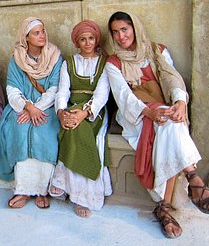
Estall via Pixabay

Photo by Ben Ostrower on Unsplash

Photo by Diana Polkhin on Unspalsh

Synagogue at Dura Europos

Shrine at Buster Ancient Farm, UK

Photo by Jonathan Ford on Unsplash

Photo by Tbel Abuseridz on Unsplash

Susan Sutherland is the author of the Leaving Bethany Trilogy. To buy Leaving Bethany, Return to Caesarea and Advance from Antioch please go to the buy page.
If you like Susan’s blogs sign up for the mailing list and receive a free copy of The Aemilia Metella Interviews.
(1) Cox, J (2024) Christian Baptism as the Gender-Inclusive Covenant Sign, available at https://www.cbeinternational.org/resource/christian-baptism-as-the-gender-inclusive-covenant-sign/#:~:text=The%20new%20covenant%20sign%20of,Christ%20independently%20of%20a%20man.
(2) Cox, J (2024)
(3) Cox, J (2024)
(4) Evans, M, (2006) Woman in the Bible, Paternoster Press, p 33
(5) Evans, M (200) p33
(6) Safrai, S (2002) The Place of Women in First-century Synagogues, available at https://www.cbeinternational.org/resource/place-women-first-century-synagogues/
(7) Gupta, N (2023) Tell Her Story, Inter Varsity Press, p 47
(8) Mowczko, M (2015) 4 Contexts of women’s Leadership in Roman Society, available from https://margmowczko.com/womens-leadership-church-1/
(9) Mowczko M (2015)
(10) Taylor, L and Bond H (2022) Women Remembered Jesus’ Female Disciples, Hodder and Stoughton, p14
(11) Taylor, L and Bond H (2022) p14
 Leaving Bethany