
Women Church Leaders
Welcome to the third of the series celebrating women pioneers of the Early Church.
Part 2 Women Theologians and Bible Translators
When we read about church leadership roles in the New Testament, it can be difficult to understand what they refer to without the following 2,000 years of church leadership terms and practices getting in the way. We often interpret them in the light of our own church tradition and the titles given to modern church leaders. Church leadership in the first few centuries of the early church was more fluid, without the official titles and ordination of the following centuries. With ordination and church hierarchy, which became increasingly male, women’s contributions were forgotten. However, as we shall see, these early church pioneers had leadership roles. This blog will peel back the layers to highlight several women who acted as bishops, presbyters, elders and even apostles.
Cerula and Bitalia
In the 1970s, researchers discovered the grave portraits of two women in the San Gennaro Catacombs in Naples, Italy, dating back to the fifth or early sixth century. We know the tomb is of a woman called Cerula because of the inscription Cerula in Pace, meaning Cerula, Rest In Peace. We also know that she had a religious role because of the Christian symbolism around her image. The chi-rho and alpha and omega symbols appear above her head. Alpha and Omega are the first and last letters of the Greek alphabet, meaning God is the first and the last, and all in between. The chi-rho is the superimposing of the first two Greek letters of the word Christ and is one of the earliest Christian symbols.
On either side of her are four open codices or books with the names of the four evangelists or gospel writers. A wall fresco of St. Paul gestures towards her, as if in blessing, and another of, possibly Peter, or another saint, which unfortunately has not survived. On a wall to the side of Cerula’s is a portrait of Bitalia, and like Cerula, she has her arms raised with open gospel books, with a red chi-rho symbol above her head.
If we examine the portraits of another tomb nearby, we can see similarities with the symbols. In the crypt of the bishops, the symbols are not present, but the men are identified as bishops. Both symbols are present in the halo of Saint Gennaro, the martyr bishop, after whom the catacombs are named. Saint Gennaro has his arms raised like the women.
Cerula and Bitalia are shown wearing an overgarment, a paenula, which Mary M Schaefer likens to a short chasuble identical in style to Pope Clements more ornate one. (1) They are similar to the vestments worn by the women shown processing towards the altar in the sixth-century ivory pyx, which is the small vessel used to carry the Eucharist or Holy Communion. Three of the women have their arms raised.
The names of Mark, John, Luke and Matthew are written on the open books on either side of Cerula and Bitalia. Specialists from the Vatican have identified the portraits of unnamed men in the catacomb, shown holding closed books as bishops, even though they are unnamed and do not have the same chi-rho and alpha and omega symbols as the women. Ally Kateuz explains how open books were associated with bishops and ecclesial authority, and were, as they are still today, ordained with an open gospel book above their heads. (2)
One of the earliest portraits of women in a similar way to Cerula and Bitalia is the fourth-century fresco in the Domitilla Catacomb in Rome, which depicts two women named Veneranda and Petronella. These and the ones of the two women in Naples demonstrate how women in these early centuries could function as bishops.
Bishop Theodora
Theodora remains mostly unknown, except for an inscription found in an eight-century mosaic in St. Zeno’s chapel in the church of Saint Praxides in Rome. They may be older than the eighth century and have been moved from a previous site. The mosaic is of four women, three with round halos and one, named Theodora with a square halo, meaning she was alive. She wears a white coif, a close-fitting cap to signify that she was unmarried.
The inscription above her head reads Episcopa, which is the feminine form of Episcopus, meaning Bishop. Scholars now believe that the name which reads Theodo is a later attempt to change her name to make it masculine. Gold tesserae has covered the final two letters of her name. There is no known reference to Theodo as a man’s name. (3)
Ammia of Philadelphia
Ammia was a first or second-century prophetess from Philadelphia. Little is known about her now, but she must have had a significant reputation in her time. She is mentioned by the fourth-century church historian, Eusebius. He says, “Agabus, or Judas, or Silas, or the daughters of Philip, or Ammia in Philadelphia, or Quadratus.” (Church History 5.17.2-4)
Agabus, Silas, and Philip’s daughters are mentioned in Acts as prophets, but Ammia and Quadratus are not mentioned. Suggesting that they soon followed the closure of Acts, and their ministry was similar to the others mentioned.
Eusebius says that Quadratus and Philip’s daughters are called the successors of the Apostles. They built upon the foundations laid by them, and as such, they were known and celebrated. As he places Ammia’s name between Philip’s daughters and Quadratus, we can assume he meant her as well.
As the church grew and consolidated the holy orders, the office of the prophet disappeared, and women’s voices became increasingly silenced. (4)
Women Apostles
Several women from the early church, including Mariamne, Irene, Nino, and Thecla, were known as apostles. In addition to Junia in the New Testament being referred to as an apostle, we can see that women often both fulfilled those roles and were remembered as apostles. We read about them evangelising, baptising and exorcising, all activities associated with male apostles.
I will return to these women and explore their lives in more detail, including how they acted as apostles, in my next blog about women evangelists of the early church.
Leta the Presbyter
There is a fifth-century sepulchre in Brittium, modern day Calabria, Italy, which reads, “Leta the Presbyter lived 40 years, 8 months, 9 days, for whom her husband set up this tomb. She preceded him in peace on the day before the Ides of May.”
Here the husband of Leta, calls his wife a presbytera, without calling himself a presbyteros. The Greek presbyteros might mean an older man or in this context an “elder”, a church leader. Both the masculine and feminine forms of the word can be found in the New Testament. The feminine form may be associated with the order of widows, as mentioned by Paul, but Leta was not a widow at the time of her death. Some later evidence suggests that it is an alternative term for an abbess.
Some have suggested that terms such as presbytera refer to the wife of a presbyeros, but Leta’s husband makes no reference to a title for himself or even his name. At other times when a presbyteros prepares a tomb for his wife, he calls her coniux, (spouse) or amantissima (beloved). (5)
Conclusion
Often it is only with only a fleeting glimpse we get to know these valiant women of the early church. We see them in frescoes, named on tombs and in old texts, but their names and stories are slowly coming to light. During their lifetimes, they were thought worthy of remembering and we must not let their names be forgotten. They are true pioneers of the early church, who refuse to be overlooked.
“The question is: once these women are truly remembered, where will we go from here?” (6)

Cerula in the catacombs of San Gennaro From https://margmowczko.com/cerula-bitalia-catacombs/


Women clergy at the altar of the Anastasis Church in Jerusalem from https://allykateusz.org/books/
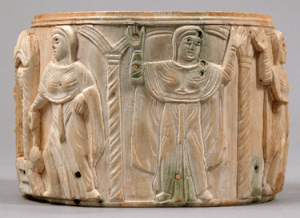
Women in the Liturgical Procession from https://allykateusz.org/books/
Open books were associated with bishops and ecclesial authority

Image from wikipedia

Image from wikipedia
“Agabus, or Judas, or Silas, or the daughters of Philip, or Ammia in Philadelphia, or Quadratus.” Eusebius Church History 5.17.2-4)
“Leta the Presbyter lived 40 years, 8 months, 9 days, for whom her husband set up this tomb. She preceded him in peace on the day before the Ides of May.”
Often it is with only a fleeting glimpse we get to know these valiant women of the early church.
“The question is: once these women are truly remembered, where will we go from here?”
Taylor and Bond

Susan Sutherland is the author of the Leaving Bethany Trilogy. To buy Leaving Bethany, Return to Caesarea and Advance from Antioch please go to the buy page.
If you like Susan’s blogs sign up for the mailing list and receive a free copy of The Aemilia Metella Interviews.
(1) Kateuz, A. (2019). Mary and Early Christian Women Hidden Leadership, Palgrave Macmillan, page 157
(2) Kateuz, A as above
(3) Kateusz, A https://allykateusz.org/art-as-text-powerpoints/making-bishop-theodora-male/)
(4) Kidson, L. (2018), Ammia in Philadelphia, downloaded from https://engenderedideas.wordpress.com/2018/05/28/ammia-in-philadelphia/
(5) Pursiful, D. (2001) Ordained Women of the Patristic Era. Pricilla Papers, Vol 15 no.3
(6) Taylor, J and Bond, H. (2022), Women Remembered Jesus’ Female Disciples, Hodder and Stoughton, p 184
 Leaving Bethany
Absolutely fascinating! Thanks Sue 🙂
LikeLike