
This is my third post about Hildegard of Bingen, a twelfth-century nun from what is now Germany. She was an abbess, visionary, poet, physician, prophet, preacher, theologian, political advocate, and a composer. In my first post, I outlined Hildegard’s life and work, and in my second, The Green Finger of God, I examined her writing and music. In this post, I look at her theology of the incarnation.
The incarnation is the belief that God became human in the person of Jesus Christ, who was both fully human and fully divine. It is at Christmas, more than at any other time, that we celebrate God’s coming to earth. For Hildegard, the incarnation was the pivotal moment when creation reached perfection and was one of her characteristic themes, lying at the heart of all she taught or wrote.
She taught that the incarnation was the movement between the creation of the world by the Word of God and God’s recreation of the Word made flesh in Jesus.
“In the beginning was the Word, and the Word was with God, and the Word was God. He was with God in the beginning. Through him, all things were made; without him nothing was made that has been made…. The Word became flesh and made his dwelling among us.” (John 1:1-3 and 14 NIVUK)
This is her position on the “eternal predestination of Christ” (1). She said that Christ’s coming, or incarnation, was predestined for creation from before all time, and was not a “backup plan” after the Fall.
Eve-Mary
As a theologian and composer, Hildegard made links between things that we as modern-day Christians might not recognise. She recognised the link between Eden and the Incarnation, because one man’s sin, Adam’s, brought death. But as Romans 5:17 says, it is through God’s wonderful grace that we can have life through the one man, Jesus Christ. Echoing Paul, Hildegard paired Adam with Jesus.
Going further, Hildegard paired Eve with Mary. As with Adam, it was through Eve that sin entered the world, and it would be another woman, Mary, through whom life entered the world. We often bring our assumptions into the pairing of Eve and Mary. Historically, Eve has been blamed for the Fall and even for Christ’s death, who had to come to save us from sin. Along with the blaming of Eve, Protestant Christians have often underplayed the role of Mary in the incarnation.
Hildegard’s words are helpful for us in reflecting on God, who used the humblest of servants, Mary, to fulfil his plans.
Because a woman instituted death;
The clear Virgin has abolished it.
(Antiphon 7)
She was not saying that it is Mary who abolished death, but Christ who came from her. God chose a woman to bring his son into the world to save men and women from the deception of the devil.
Eve brought sin, but Mary brought life. “Yet Eve was not death and sin personified, and Mary was not everlasting life and salvation personified.” (2) Chosen by God, it was Mary who would bring forth the one who would bring salvation and everlasting life. Who in first-century Nazareth would have believed that God chose this young woman, after 400 years of silence, to bring God into the world as human?
The highest Word
In you took on flesh.
…your body contained joy
…virgin, you carried the Son of God
(Hymn 12)
Conclusion
I have enjoyed researching and writing my mini-series of three posts on Hildegard of Bingen. Hildegard and the women of church history have left a legacy and a lasting impact on today’s church. One that has for too long been neglected, and it is time their stories were better known.
“What if our Sunday school and Bible study curriculum correctly reflected Junia as an apostle, Priscilla as a coworker, and women like Hildegard of Bingen as preachers? What if we recognized women’s leadership the same way as Paul did throughout his letters – even entrusting the Letter to the Romans to the deacon Phoebe? What if we listened to women in our evangelical churches the way Jesus listened to women? Women stand with a great cloud of witnesses. We always have. It is time, far past time, for us to remember.”
I will leave the last word to Hildegard and her song O Vis Eternitatis, Responsory for the Creator and Redeemer
Listen to the song here: https://www.hildegard-society.org/2014/06/o-vis-eternitatis.html
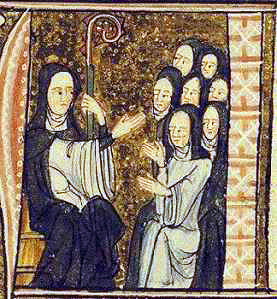
Hildegard and her nuns
“The Word became flesh and made his dwelling among us.”
Because a woman instituted death;
The clear Virgin has abolished it.
(Antiphon 7)
The highest Word
In you took on flesh.
…your body contained joy
…virgin, you carried the Son of God
(Hymn 12)
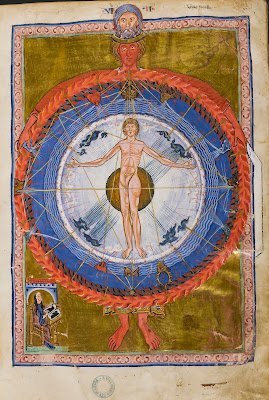
The cosmic spheres and Human Being
“O power within Eternity:
All things you held in order in your heart,
And through your word were all created
According to your will.
And then your very Word was clothed within
That form of flesh from Adam born.
And so his garment
were washed and cleansed from greatest suffering.
How great the Saviour’s goodness is!
For he has freed all things
By his own Incarnation,
Which divinity breathed forth
Unchained by any sin.

Susan Sutherland is the author of the Leaving Bethany Trilogy. To buy Leaving Bethany, Return to Caesarea and Advance from Antioch please go to the buy page.
If you like Susan’s blogs sign up for the mailing list and receive a free copy of The Aemilia Metella Interviews.
(1) International Society of Hildegard von Bingen Studies https://www.hildegard-society.org/2014/06/o-vis-eternitatis.html
(2) Emma Yeager, “The Serpent Has Suffocated in a Woman”: Eve and Mary in the Liturgical Songs of Hildegard of Bingen https://www.cbeinternational.org/resource/the-serpent-has-suffocated-in-a-woman-eve-and-mary-in-the-liturgical-songs-of-hildegard-of-bingen/
(3) Beth Allison Barr, The Making of Biblical Womanhood: How the Subjugation of Women Became Biblical Truth. (Brazos Press, 2021), 214.
 Leaving Bethany