Women Martyrs
I recently bought a book “The Story of Christianity 2,000 Years of Faith”, published in 2000 by Dorling Kindersley to celebrate the millennium. I found it languishing on a shelf in a charity shop and thought it might be interesting. Opening it I was struck by how few women were mentioned in its pages, so going through the index I took a tally. Out of the 677 people mentioned, only 53 are women, that’s only 7.8%. Counting the number of men called John or the alternate forms of the name, there are 38. There are almost as many men called John as there are women! What does this tell us?
Assuming there have always been about 50% of the church who are women, why are they not represented in the church history books? Does this mean that very little of any significance was achieved by women in the last 2,000 years, or their contributions and stories have been forgotten, or worse, deliberately suppressed?
My novels and blogs celebrate the women of the New Testament, revealing how Jesus interacted with women and highlighting their contribution to the growth of the church. The church of the first century CE was led initially, by those who walked and talked with Jesus and they continued not only his teachings but his way of including everyone, which meant women as well as men.
In this new series of three blogs, I want to celebrate the women pioneers of the church in the early years after the closing of Acts. In this first blog, we look at those brave women who were prepared to risk everything, even their lives, to follow Jesus and in the end died as martyrs.
The first major wave of persecution came immediately after the closing of Acts. In 64 CE, a fire in Rome destroyed over three-quarters of the city, and Emperor Nero, who was blamed for it, turned his attention to the Christians who were even less popular than he was. According to the historian, Tacitus, an immense multitude of Christians were convicted and ripped apart by wild dogs, crucified or set alight to illuminate the night. (1) It is likely that Simon Peter was caught up in this and by tradition, crucified upside down, and Paul, as a Roman citizen, was beheaded. Many unnamed Christians, both men and women were executed and martyred. How many of those named in Paul’s list at the end of his letter to the Romans were killed? Perhaps Priscilla and Aquila or Andronicus and Junia?
Basilissa and Anastasia
We know of two women who were martyred around this time. Basilissa and Anastasia were said to have been converted by Peter and Paul, and after their death, retrieved their bodies and took them away for a reverent burial. News of this reached Nero and he had the two women imprisoned. Despite torture, they remained strong and professed their faith until they too were beheaded by the sword in about 68 CE. (2)
Photine, The Samaritan Woman at the Well
Another tradition concerns the Samaritan woman Jesus met at the well, whose story is told in John’s gospel. The Gospels do not tell us her name, but according to tradition, it was later changed to Photine, meaning luminous one. During Nero’s persecution, Photine was in Carthage, in modern-day Tunisia, where she fearlessly preached the gospel and was described as “equal to the apostles”. News of her reached Nero, who sent for her to be brought to Rome to answer charges of being a Christian, which was by then an outlawed religion. After many tortures, she was thrown down a dry well where she died. Some traditions say she died alongside her sons and sisters. (3)
Perpetua and Felicitas
For once we know the exact date. It was the 7th of March 203, and a group of men and women were led into the amphitheatre in Carthage to be executed for being Christians. The most well-known of these was a slave called Felicitas and a well-born woman called Vibia Perpetua.
The Passion of Perpetua and Felicitas is an account of their trial, imprisonment and final martyrdom. More than a third is written in the first person and we hear Perpetua’s voice from prison. Scholars now agree that Perpetua wrote her prison diary, the first autobiographical account written by a woman. (4) Later someone added the account of their deaths.
Both women were married, Perpetua had a young son who she was still breastfeeding and Felicitas was pregnant when they were arrested. Perpetua describes how her father tried many times to get her to recant her Christianity and worship the emperor, to save her life, but she refused. She replied, “I cannot be called anything other than what I am, a Christian.” (5)
Perpetua recounts her visions whilst in prison and how she encouraged the small group as the day drew near. After Felicitas gave birth to her child they were led into the amphitheatre. The two women were first gored by a heifer until the crowd shouted that it was enough. In a show of solidarity, both the slave and high-born women clung to each other for comfort. They were then killed by gladiators. According to tradition, it was a young gladiator sent to dispatch Perpetua, she took his trembling hand and guided his sword to her throat.
Conclusion
It is a paradox that in times of persecution the church grows. As true today as it was in the first centuries. We owe a debt to these brave women and men who faced torture, often too horrendous to describe here, and offered up their very lives, rather than deny their faith in Jesus.
At a time when women were seen as the weaker vessels, these women and many, many more showed true strength, courage and fortitude in confessing their faith. They were prepared to stand beside their brothers to face torture and death together. There was nothing weak about them. Their death and torture were so horrendous that I have chosen not to describe many of the gorier details of their torture and punishment.
Tertullian, a third-century theologian from Carthage commented upon the death of Perpetua and Felicitas and the other martyrs, warning that Christianity could not be defeated this way. “Your cruelty, however great, is a better advertisement for us than for you. The more you mow us down, the more we grow. The blood of Christians is seed.” (6)
Next month I will look at women translators and theologians of the first few centuries.

The Christian Martyrs Last Prayer by Jean-Léon Gérôme 19th Century

Menologion of Basil II. The Holy Great-martyr Anastasia the Deliver from Bonds, and other with her. 11th Century
Photine “Equal to the Apostles”.
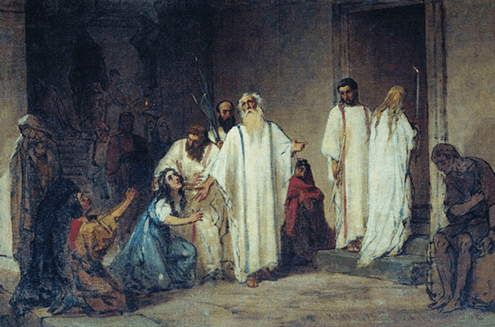
Fyodor Bronnikov, Before entering the Arena, 1873
“I cannot be called anything other than what I am, a Christian.” Perpetua
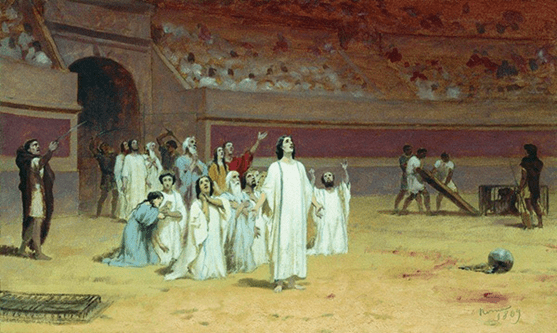
Fyodor Bronnikov, Entering the arena, 1869
“The blood of Christians is seed.” Tertullian

Susan Sutherland is the author of the Leaving Bethany Trilogy. To buy Leaving Bethany, Return to Caesarea and Advance from Antioch please go to the buy page.
If you like Susan’s blogs sign up for the mailing list and receive a free copy of The Aemilia Metella Interviews.
- Page, N. (2012), Kingdom of Fools, Hodder and Stoughton, p332
- Orthodox Church of America https://www.oca.org/saints/lives/2024/04/15/101086-martyrs-basilissa-and-anastasia-of-rome-disciples-of-apostles-pe
- Orthodox Church of America https://www.oca.org/saints/lives/2020/03/20/100846-martyr-photini-the-samaritan-woman-her-sons-and-those-with-them
- Schroder, J.A and Taylor, M.A. (2022) Voices Long Silenced, Women Biblical Interpreters Through the Centuries, Westminster John Knox Press, page 13
- https://www.ssfp.org/pdf/The_Martyrdom_of_Saints_Perpetua_and_Felicitas.pdf
- Page, N. (2013), The Nearly Infallible History of Christianity, Hodder and Stoughton, page 650
 Leaving Bethany
Excellent and fascinating facts. Thank you Susan
LikeLike
Thanks Dawn, I’ve spent the last year reading about church history and the forgotten voices of the women who played a pivotal part. So, I wanted to write about some of these courageous women.
LikeLiked by 1 person
I’m very grateful that you did. I looked up some of those courageous women who were shockingly martyred and read the stories. Amazing
LikeLike