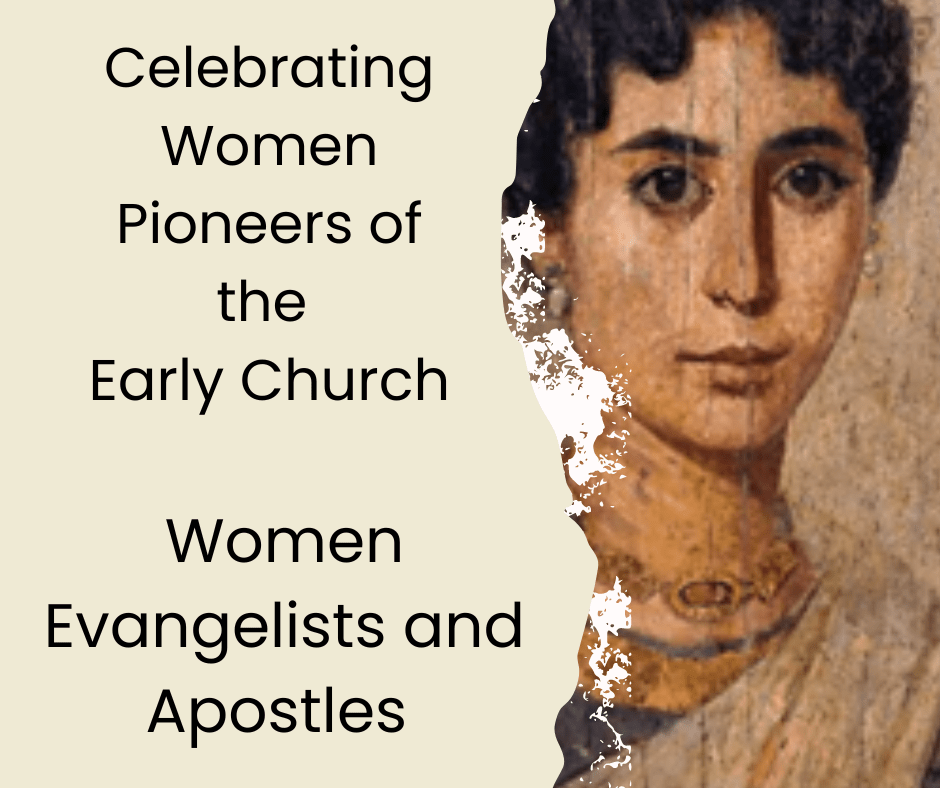
Women Evangelists and Apostles
Welcome to the fourth in our series celebrating the women pioneers of the Early Church. Catch up with the first three here:
Women Theologians and Bible translators
We read in the New Testament of the twelve apostles, the twelve men who were Jesus’ closest disciples. Later in Acts, we see more people being described as apostles, including Paul, who added married couple Andronicus and Junia to the list (Romans 16:7). The first apostles had followed Jesus and saw his resurrection, but in later centuries, those with an evangelistic and missionary work were often called apostles.
“An apostle was sent to preach and to grow church communities, necessitating skills of leadership, communication, vision and spiritual wisdom.” (1) Thecla, Irene and Nino were three early church pioneers who possessed these skills and carried out the work of an apostle, and were called such in their lifetime or shortly after.
After the first century, and at the end of the New Testament era, the accounts of the lives of the saints become airbrushed, and they seem to lead unblemished and miraculous lives. In his letters and the account in Acts, Paul was very honest about his trials and difficulties. We miss this forthright honesty in the tales of the lives of later saints, which were written to inspire other Christians rather than give an honest account of their lives. Because of this, it is often difficult to discover the genuine women behind these stories.
Thecla
In Acts 14, we read of Paul and Barnabas, in what we now call Paul’s first missionary journey, in Iconium, in modern-day Turkey. A young woman sat in her window listening to Paul, who, day after day, preached to the crowds. To the astonishment of her widowed mother and fiancé, Thecla became a Christian and decided to give up her privileged lifestyle and dedicate her life to following Jesus and remaining a virgin.
Following the break of her engagement, her mother and fiancé condemned her to be burnt alive, but a large rain cloud put out the fire. Miraculously, she survived this and other attempts to kill her, and sometimes had to disguise herself as a man to escape her pursuers.
We discover her story in the Acts of Paul and Thecla, written in about 150 AD. Not featured in the canon of the Bible, it is an Apocryphal work. Sometimes fanciful, it is difficult to find the real Thecla among the legends.
Most likely Thecla was a first-century itinerate preacher and co-worker of Paul, who commissioned her to “go and teach the word of God.” With his encouragement, she returned to Iconium, where she preached outside her old home as Paul had. (2) Later, she settled for many years in a desolate place near Isaurian Seleucia, where she constantly preached, baptised and healed many through prayer. (3) Some early church leaders tell of the monasteries, teaching centres and a hospital which were built because of her teaching.
Even though the Acts of Paul and Thecla were never in scripture, the church fathers did not question the historical Thecla, as a true follower of Christ. The Orthodox Church regards her as Equal to the Apostles, and she was regarded as a saint by the Catholic Church until 1969 when she was removed from the list. (4) Many murals and artefacts are found celebrating her life and work, and some show her beside Paul, suggesting she was remembered as a prominent teacher and preacher.
Irene
Irene is known as Saint Irene of Macedonia, and there are two stories about her life. One calls her an evangelist who converted 10,000 people to Christ in various cities, while another calls her an apostle.
According to tradition, she was about to be married when she met Timothy, who came with letters from Paul. He taught and then baptised her. Later, she told her father and other prominent men of the city that she would be a bride of Christ, and then broke the idols of her city and exorcised a demon. When her father was killed, she raised her hands and prayed that he would be raised to life, which he was. The text tells us that Irene “remained in the city doing miracles and signs and cures. And she taught the word of truth and instructed many, and baptised them.” (5)
Nino
In 337 AD Iberia, the Roman name for modern-day Georgia, was one of the first countries to make Christianity the official religion, largely thanks to Nino, or Nina as she is sometimes known. (6) Nino is venerated as a saint, by both the Orthodox and Catholic churches, and is referred to as “Equal to the Apostles and Enlightner of Georgia.” One story of her life is written in the “Life of Nino”. She is mentioned by Rufus, a fifth-century church historian (7)
In one account, Nino describes her ordination by her uncle, the patriarch of Jerusalem. “My holy father patriarch, my mother’s brother, called me and placed me on the steps of the altar and laid his hands on my shoulders. He signed towards the heavens and said, ˋO, Lord, God of fathers and ages, into Your hands I place my sister’s orphan child, and I send her to preach Your divinity, so that she may spread the good tidings of your resurrection.ˊ” (8)
Another legend says at one time when she was feeling discouraged, she had a vision of an angel handing her a scroll. on which several verses from the New Testament were written. Many of these referred to the work of women in missionary work, including:
“There is no male or female, but you are all one.” (Galatians 3:28)
“Go and teach all the nations, and baptise them in the name of the Father and of the Son and of the Holy Spirit.” (Matthew 28:19) (9)
She converted many villagers to Christianity, and one story tells us how in Armenia in 301 AD she suffered persecution, and 35 nuns who were travelling with her were killed and Nino alone escaped.
She arrived in Iberia in the year 320 and news of her prayers for the sick came to Queen Nana of Iberia, who was ill. After Nino’s prayers, she recovered and became a Christian. This incensed the pagan King, Mirian III, who refused to believe. One day he was hunting and decided to have all the Christians put to death, but darkness blinded him and he prayed to the God of Nino. After his healing, he converted and was one of the first monarchs to embrace Christ and make Christianity the state religion of Iberia.
Nino remained In Iberia until she died in about 334 AD, and was entombed in a church as the King wished. Visitors can still see her tomb at the Bodbe Monastery in Kakheti in Eastern Georgia. (10)
Conclusion
We often imagine that there was a clear demarcation between the end of the events in the New Testament, and what came after, but the church fathers recognised a continual river flowing from one century to the next. (11)
The river keeps on flowing to this day, and we can celebrate these pioneering women of the early church and those who came after them. They may not have considered themselves as such, but they have been role models for both women and men to follow over the centuries. Bringing their stories into the light helps us to see that they are still our role models today.
Next month, we shall look at the desert mothers who lived as ascetics in desolate places and influenced later monastic traditions.
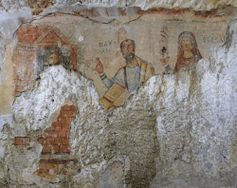
Thecla in her window listening to Paul and on the right, her mother. Sixth century fresco in the Grotto of St. Paul in Ephesus https://www.ephesustravelguide.com/
in later centuries, those with an evangelistic and missionary work were often called apostles.
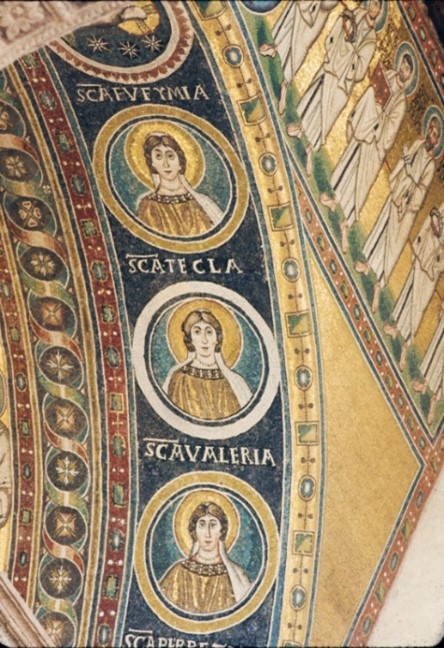
Mid sixth-century mosaic in the presbytery arch in the Basilica Eufrasiana in Poreč, Croatia. https://onceiwasacleverboy.blogspot.com/2015/09/st-thecla.html
Paul commissioned Thecla to “go and preach the word of God”
Irene “remained in the city doing miracles and signs and cures. And she taught the word of truth and instructed many, and baptised them.”

St. Nino https://en.wikipedia.org/wiki/Saint_Nino
“I send her to preach Your divinity, so that she may spread the good tidings of your resurrection.”
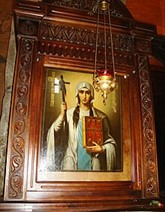
Icon of St. Nino at Svetitskhoveli Cathedral https://en.wikipedia.org/wiki/Saint_Nino
The church fathers recognised a continual river flowing from one century to the next.

Susan Sutherland is the author of the Leaving Bethany Trilogy. To buy Leaving Bethany, Return to Caesarea and Advance from Antioch please go to the buy page.
If you like Susan’s blogs sign up for the mailing list and receive a free copy of The Aemilia Metella Interviews.
(1) Bruce K and Shercliffe L, (2021), Out Of The Shadows Preaching The Women Of The Bible, SCM Press, P194.
(2) Mowczko M, (2018), Three Legendary Ladies: Judith, Thecla and Catherine of Alexandria, https://margmowczko.com/judith-thecla-catherine-of-alexandria/
(3) Orthodox Church of America, Protomartyr and Equal to the Apostles Thekla, https://www.oca.org/saints/lives/2022/09/24/102715-protomartyr-and-equal-of-the-apostles-thekla)
(4) Tucker R, (2016), Extraordinary Women of Christian History, Baker Books.
(5) Smith Lewis, Select Narratives, quoted in Kateuz A, (2019) Mary and Early Christian Women, Palgrave Macmillan, p55
(6) Mowczko M, (2012), Nino of Georgia: A Woman Evangelist “Equal to the Apostles”
https://margmowczko.com/nino-of-georgia/
(7) Phillips JK, Attitudes to Women Leaders in the Early Church, (2010), https://www.academia.edu/10944321/Attitudes_to_woman_in_the_early_church
(8) Kateuz A, (2019) Mary and Early Christian Women, Palgrave Macmillan, p55
(9) Mowczko M, (2012)
(10) Friesen L, (2015) Women’s History Month: The Early Church https://www.cbeinternational.org/resource/womens-history-month-early-church/
(11) Tucker R, (2016), Introduction p ix
 Leaving Bethany
Makes me want to go to Georgia now! Thank you.
LikeLike