Women Poets and Writers
As a writer, I was fascinated to discover that women were writing their thoughts, hopes and ideas way back in antiquity, and women writers are not a new thing. I want to round off this series of women pioneers of the Early Church with a look at three women writers to discover what has survived of their writing, and the influence they have had.
Cento
A cento, literally a patchwork quilt, was a poetic art form in late antiquity where a writer would show their skill by creating, or stitching together, lines from the epic verses of the classics, such as Homer or Virgil to create a new artistic whole. (1) Audiences and readers would recognize the classical source material and appreciate how they refer to the new work. As both a writer and someone who has made patchwork quilts, I can see how this art form was used by writers to tell new stories of their Christian faith.
The writing of both Faltonia Betitia Proba and Aelia Eudocia was until recently dismissed, but recent studies into their work are bringing them to light once more.
Faltonia Betitia Proba (ca.320 – ca.370)
Proba came from a wealthy Roman family and embraced Christianity later in life. Her husband and sons eventually joined her in her faith. She would go on to be recognised as one of the most prolific female poets of ancient times.
She was the author of Cento Vergilianus and referred to herself as “Proba Vates” meaning prophet or bard. This work retells Genesis chapters 1-4 and the Gospel of Matthew. The stories of Jesus’s birth focus on Mary as the central character, and she goes on to describe Jesus’s ministry, passion and ascension.
Of the creation, she writes:
“Then God, all powerful, to whom belongs Supreme dominion of the universe, Moved murky air apart, dispelled the shades, Gave half the world to light and half to gloom. All constellations wheeling in the silent sky He marked, surveying here and there with watchful eyes.” Proba Cento lines 64-68 (2)
The Cento Probae was first published in 1472 and enjoyed popularity in the Middle Ages. It is quite possible that Proba was the first woman author to have her work made available in print. (3)
Aelia Eudocia Augusta (ca. 400- 460)
Eudocia’s father was Leontius, a Greek philosopher, who taught his daughter alongside his sons. She was well versed in the Greek classics which she would have memorised. After he father’s death she moved to Constantinople and became friends with the emperor’s sister, who introduced her to Emperor Theodosius. They were later married and Eudocia was baptised a Christian and given the name Augusta.
She went on a pilgrimage to Jerusalem and permanently moved there in 443. While there, she worked on both philanthropic and literary work, including a paraphrase of the first eight books of the Old Testament and Daniel and Zechariah. Unfortunately, these are now lost.
Her principal work is the Homerocentones (Homeric Centos) comprising 2,400 lines. She says that it was an expansion of a fourth-century bishop called Patricius, of whom little is known. She corrected his work and added three-quarters of the poem’s lines. It briefly covers the creation and fall, but centres on the life of Christ.
Following the church tradition of the time, she imagines Mary spinning wool when the angel appears.
“He entered an elaborate room – there was the girl, Sitting on a couch, a footstool supporting her feet as she spun yarn into a thread, a wonder to see.” Homerocentones lines 209-11 (4)
Both Proba and Eudocia used their background and education in classical Greek literature and the form of the centos to teach their Christian faith. They have been criticized, both at the time and more recently, for using the pagan Greek texts, but they repurposed the art form of the centos, as something that readers would understand to share their faith. This is something I do, as a writer of Biblical Fiction, I use the art form of a novel to reimagine the gospels and share my faith.
Egeria (Fourth Century)
Egeria, also known as Eteria, was a fourth-century pilgrim from Gaul or northern Spain, who travelled to the Holy Land to visit sites from Scripture. In a Latin diary dated to the early 380s, she detailed her travels and experiences.
She addressed her diary to “ladies” or “reverend sisters”, suggesting she may have belonged to a religious order or a group of laywomen. Her diary contains an account of the sites she visited alongside descriptions of early Christian liturgy in Jerusalem.
It was her custom to arrive at a site mentioned in Scripture, often after an arduous journey on foot. There, she would recite a prayer, read aloud the appropriate passage of Scripture, and sing together a psalm. Sometimes, the Eucharist was celebrated.
After she visited the cave on Horeb where Elijah fled (I Kings 19), she writes:
“We offered the sacrifice (Eucharist) there, and recited a very fervent prayer, and the proper passage was read from the book of Kings. For this was always very much our custom, that, whenever we should come to places that I had desired to visit, the proper passage from Scripture would be read.”
Egeria, Diary 54 (5)
“Yet I cannot sufficiently thank all those holy (people) who so willingly consented to receive my humble person in their cells and above all to guide me through all the places which I was forever seeking out, flowing Holy Scripture.”
Egeria, Diary 58, (6)
Conclusion
These three women writers were pioneers of the Early Church. Proba and Eudocia used an art form of antiquity, the Cento, to share their faith, and Egeria invented a whole new way of writing, now so familiar to us, the travelogue. They inspired women writers through the ages, and continue to inspire us today.
I hope you have enjoyed this series of six posts on women in the Early Church. We have visited many women, who were not merely passive bystanders but actively contributed to the building of not only the church but society as a whole. It is upon their foundation that we, both women and men of the church today, build.
In this series, we have met:
Perpetua and Felicitas united in martyrdom.
Paula and Eustochium working with Jerome on the Latin translation of the Bible.
Cerula and Bitalia, two church leaders.
Nino “Equal to the Apostles and Enlightener of Georgia.”
Amma Syncletica and Amma Theodora, whose wisdom is as relevant today.
I would like to close this series as Joan Taylor and Helen Bond close their book, Women Remembered. “The question is; once these women are truly remembered, where do we go from here?” (7)
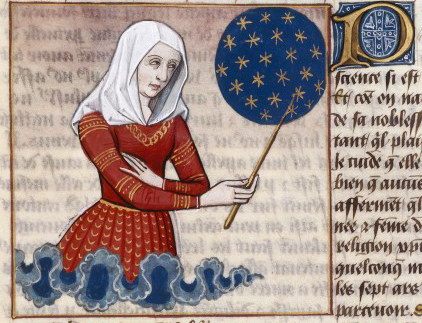
Faltonia Proba teaching the history of the world since the Creation through her Cento Vergilianus de laudibus Christi. Miniature from a 15th-century manuscript of the De mulieribus claris by Giovanni Boccaccio
“All constellations wheeling in the silent sky He marked, surveying here and there with watchful eyes.” Proba Cento
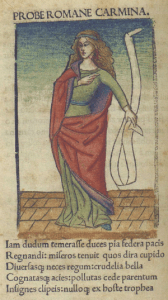
The first five lines of Cento Probae with a depiction of the author, Faltonia Betitia Proba, holding a scroll. From standrewsclassics.wordpress.com/2016/03/09/faltonia-betitia-
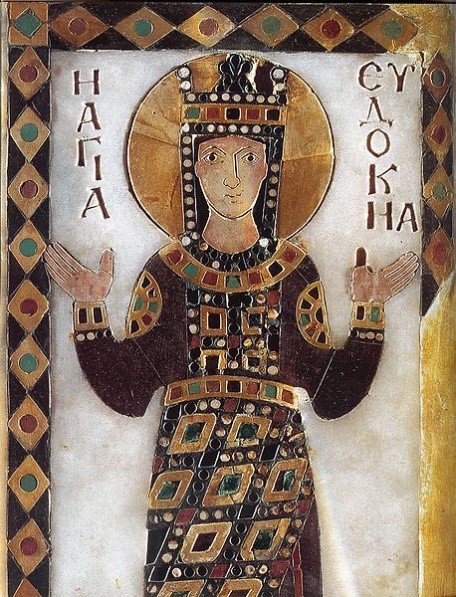
unbekannt, Pitichinaccio, Public domain, via Wikimedia Commons
“He entered an elaborate room – there was the girl, Sitting on a couch, a footstool supporting her feet as she spun yarn into a thread, a wonder to see.”
Aelia Eudocia Homerocentones lines 209-11 (4)
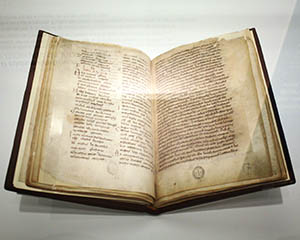
Codex Aretinus 405 contains the only surviving copy of Egeria’s Travels.
Lameiro, CC BY-SA 4.0, via Wikimedia Commons
“Yet I cannot sufficiently thank all those holy (people) who so willingly consented to receive my humble person in their cells and above all to guide me through all the places which I was forever seeking out, following Holy Scripture.” Egeria, Diary 58, (6)
“The question is; once these women are truly remembered, where do we go from here?”

Susan Sutherland is the author of three books. To buy Leaving Bethany and the sequel Return to Caesarea please go to the buy page.
If you like Susan’s blogs sign up for the mailing list and receive a free copy of The Aemilia Metella Interviews.
References
(1) Schroder J and Taylor MA (2022), Voices Long Silenced Women Biblical Interpreters Through the Centuries. Westminster John Knox Press
(2) Proba Cento lines 64-68, Quoted in Schroder and Taylor (2022) page 17
(3) Roger Rees (2016) St. Andrews Classics downloaded from https://standrewsclassics.wordpress.com/2016/03/09/faltonia-betitia-proba/#:~:text=A%20cento%20is%20a%20work,Vergil’s%20Eclogues%2C%20Georgics%20and%20Aeneid.
(4) Homerocentones lines 209-11 Quoted in Schroder and Taylor (2022) page 21
(5) Egeria, Diary 54, Quoted in Schroder and Taylor (2022) page 15
(6) Egeria, Diary 58, Quoted in Schroder and Taylor (2022) page 15
(7) Taylor J and Bond H, (2022), Women Remembered Jesus’ Female Disciples. Hodder and Stoughton. Page 184
 Leaving Bethany
I loved this, Susan. Really interesting and affirming. Thank you!
LikeLike
I loved this, Susan. Really interesting and affirming. Thank you!
LikeLike
Thank you Sarah, I have loved researching this series, and yes, I have found it affirming too. The past has so much to teach us.
LikeLiked by 1 person
You continue an auspicious practice well, Susan.
Thank you for sharing your fascinating research.
LikeLiked by 1 person
It has been a privilege to research into these forgotten women, and bring their stories into light.
LikeLiked by 1 person
Cool! Really. Cool!
LikeLike