
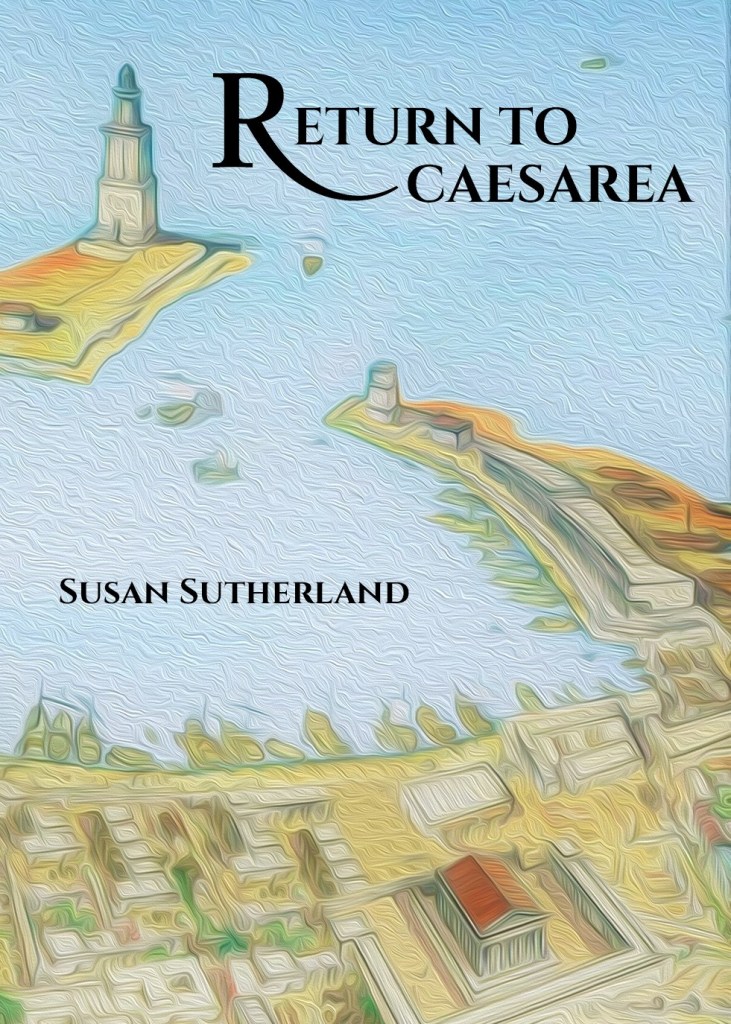
Last month I launched a blog series on the Biblical and historical basis of my novels starting with Leaving Bethany. My focus now shifts to the second novel, Return to Caesarea. It is a story where my protagonist, Martha of Bethany fights against potential murderers and her own prejudices.
It is five years after the close of Leaving Bethany and for Martha, life has become predictable. Until a familiar face arrives with bad news. A friend is in prison in Caesarea on a charge of murder and faces execution. She immediately sails to help him and unmask the real murderer.
Help comes from an unexpected source and challenges Martha’s view of who can be a follower of Jesus. She must first overcome her reticence of the gentile retired centurion before she can trust his help.
Date
Return to Caesarea occurs in the year 39AD, and for once we are certain of the year. The events with Herod Antipas and Herod Agrippa have been historically dated to the exact year. It was a year of political intrigue and growth in what we now call the Early Church, and once again, Martha and her friends are in the midst of it.
Biblical background
Jesus’s commission to take the good news out from Jerusalem and Judea to the ends of the earth was happening. A few non-Jewish people were becoming believers in Jesus, and this shock wave would have shaken the early Christians to their core and challenged their beliefs. They would face questions such as: Whose house can they enter? Who can they associate with? Who can they eat with? A deeper question would be who is acceptable to God and who can now belong to his family of believers? Martha voices these questions in her relationship with Centurion Cornelius and Captain Marcus.
Cornelius, the retired non-Jewish, or gentile, centurion converted the year before and was now a follower of Jesus. Chapter 10 of the Acts of the Apostles, a book in the New Testament, tells us his story. His conversion was an important turning point in how the church expanded to include all peoples. But it was not without problems, and Simon Peter returned to Jerusalem to face opposition. The question of how to include non-Jewish believers would rumble on for decades and is a theme I return to in my third novel, Advance from Antioch.
Saul, or Paul to use the Greek version of his name, would be instrumental in working through these challenges. Towards the end of the novel, Martha realises that everyone is equal before God, slave and free, men and women and Jewish and non-Jewish. Paul was to echo this in his letter to the Galatians, chapter 3 verse 28, written about eleven years after this book is set.
Historical background
Herodian family dynamics were very complicated and what in modern times, would be called dysfunctional. Herod Antipater, or to use his nickname, Antipas, was the son of Herod the Great and reigned from about AD 1 to 39. He divorced his first wife in favour of his niece Herodias, who was the wife of his half-brother Herod II. Antipas is better known for his imprisonment and execution of John the Baptist and the trial of Jesus.
When Martha meets the royal family, she is shocked by their behaviour and complete disregard for anyone other than themselves.
Antipas’s nephew, Agrippa, had always eyed the throne and accused his uncle of plotting rebellion. In AD 39, he travels to Rome, trying to persuade Emperor Caligula to have his Uncle Antipas deposed on the grounds of rebellion. The murder investigation takes an unexpected turn when Martha and Cornelius find a stash of military-grade weapons in the warehouse of the murdered man. Things don’t go well for Antipas and he is summoned to Rome. You can find out what happened to him in the afterward at the end of the novel.
Conclusion
I enjoy reading historical murder mysteries, and writing my second novel was fun. The murder mystery is a vehicle to tell the story of how these early Christians put Jesus’s commission to go into all the world into action. A central theme of my trilogy is inclusion. A challenge faced by the early church as they welcomed ex-pagans like Cornelius into the faith, and a struggle I will return to in my third book.
“Susan Sutherland has imagined what might have happened to Mary and Martha and the characters she wrote about in Leaving Bethany. When a character who had helped the two sisters escape from likely persecution in the earlier book needs help himself, Martha sets off on another adventure.
Return to Caesarea is a gripping story with an accusation of murder and a mystery to be solved. There are new characters, some of which also appear in the Book of the Acts of the Apostles, including Cornelius the Roman centurion. The scenes are very varied, a prison, a palace, journeys by sea and by land. Everything seems authentic in the historical setting of AD 39. There is plenty of tension; twists in the plot kept my attention. Martha’s faith shines through the story.”

Roman Cargo Ship https://uk.pinterest.com/pin/447123069258430455/
Martha fights against potential murderers and her own prejudices.
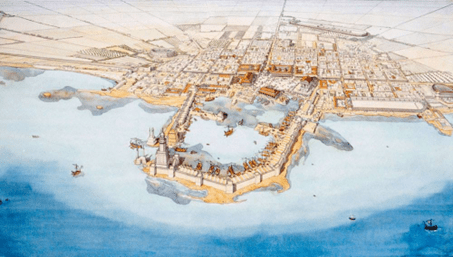
Roman Caesarea http://www.romanports.org
The question of how to include non-Jewish believers would rumble on for decades

The Hippodrome at Caesarea Madainproject.com
“There is plenty of tension; twists in the plot kept my attention. Martha’s faith shines through the story.”

Susan Sutherland is the author of the Leaving Bethany Trilogy. To buy Leaving Bethany, Return to Caesarea and Advance from Antioch please go to the buy page.
If you like Susan’s blogs sign up for the mailing list and receive a free copy of The Aemilia Metella Interviews.
 Leaving Bethany