Women of Church History
I attended Scotland’s Solas Festival in June this year, and in the programme, I noticed a workshop titled Praying with Hildegard of Bingen: Where’s our Place in the Natural World? After a scathing comment from a friend, I was determined that, out of the whole festival, it was the one workshop to attend. I had heard of Hildegard and read about her in the past, but this workshop inspired me to dig a little deeper into her life. In this new series of blogs, we will look at her life, her writing and her music.
On October 7th, 2012, Pope Benedict XVI named St. Hildegard of Bingen as a Doctor of the Church, one of only four women to hold that title. The others are Catherine of Siena, Saint Teresa of Ávila, and Saint Thérèse of Lisieux. Until 1970, there were no women doctors of the church. A Doctor of the Church is a canonised saint who is recognised for making a significant contribution to faith and doctrine through their theological knowledge and writing. This title is a rare honour and recognises her significant contribution to the church’s theological tradition. It is rarely bestowed on anyone, especially a woman.
Hildegard of Bingen, (1098-1179), a 12th-century nun from what is now Germany, was an abbess, visionary, poet, physician, prophetess, theologian, political advocate, and composer. Recently, she has been called an ecologist, scientist, and feminist. She wouldn’t have used many of these titles, as some of these terms are modern inventions. But she genuinely was all of those and can be regarded as a polymath. Few individuals have accomplished so much. One might compare her to Leonardo da Vinci, but unlike Hildegard, he was renowned for not completing projects.
After experiencing visions as a young girl at the age of eight, her parents sent her to the hermitess Jutta, where she received a basic education. When she died, Hildegard assumed leadership of the monastic community that had gathered around Jutta.
Since she was a small child, she had received visions while in prayer, and she wanted to write them down, but hesitated out of concern for what others would say about them. After discussion with her confessor, she wrote her mystical revelations of Christ’s love, angels and hell. The local archbishop declared them authentic after examining them. St. Bernard of Clairvaux, attesting to their authenticity, supported and encouraged her writing.
“The visions I saw I beheld neither in sleep nor dreaming nor in madness nor with my bodily eyes or ears, nor in hidden places. I saw them in full view and according to God’s will. When I was wakeful and alert, with the eyes of the spirit and the inward ears. And how this was brought about is indeed hard for human flesh to search out.”
Her works include three theological books, a morality play, two scientific works, a large body of music and hundreds of letters. She even went so far as to invent her own language.
When a major dispute arose between the Holy Roman Emperor Barbarossa and the pope, she wrote to both of them, giving advice and even daring to criticise the two most powerful men of her time.
When Hildegard began sharing her visions with her scribe, the monk Volmar, after 1141, she began to make plans for her own monastery. But she would be nearly fifty when she was influential enough to realise those plans to build at Bingen, in the Rhineland.
Many explanations, such as migraines, have been put forward as an explanation for Hildegard’s visions. Whatever the reason for them, her body of work would be exceptional in any age. More so considering she was a woman from the twelfth century.
“Hildegard was a woman whose voice still cries out as loudly today as it did 900 years ago.” Janina Ramirez, Femina, A New History of the Middle Ages, Through the Women Written Out of It, Penguin, 2022.
Next month, we will examine Hildegard’s scientific and musical contributions, and in December, look at her thoughts on the incarnation.
If you would like to listen to some of her music in the meantime, you can find De Spiritu Sancto (Holy Spirit, The Quickener Of Life) on YouTube

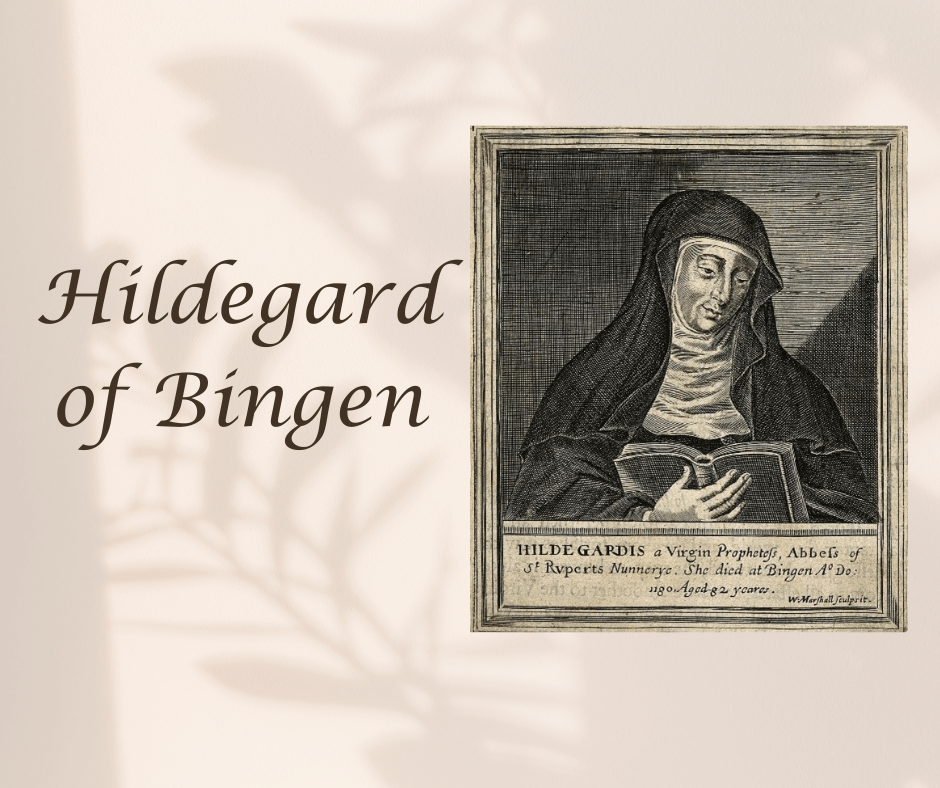
An engraving by W. Marshall of the Benedictine abbess Hildegard of Bingen (1098-1179 CE)
“The visions I saw I beheld neither in sleep nor dreaming nor in madness nor with my bodily eyes or ears, nor in hidden places. I saw them in full view and according to God’s will.”
Hildegard of Bingen

Hildegard of Bingen receiving divine inspiration and dictating to a scribe. This illustration is copied from the frontispiece to the Rupertsberg manuscript of Scivias.
“Hildegard was a woman whose voice still cries out as loudly today as it did 900 years ago.” Janina Ramirez

The Universe from the Scivias, ca. 1165, by Hildegard von Bingen

Susan Sutherland is the author of the Leaving Bethany Trilogy. To buy Leaving Bethany, Return to Caesarea and Advance from Antioch please go to the buy page.
If you like Susan’s blogs sign up for the mailing list and receive a free copy of The Aemilia Metella Interviews.
 Leaving Bethany
Very interesting lady! I look forward to part 2 🙂
LikeLike
Yes, she is a very interesting lady, and I wonder what she would achieve if she were alive today. I will continue her story next month.
LikeLike