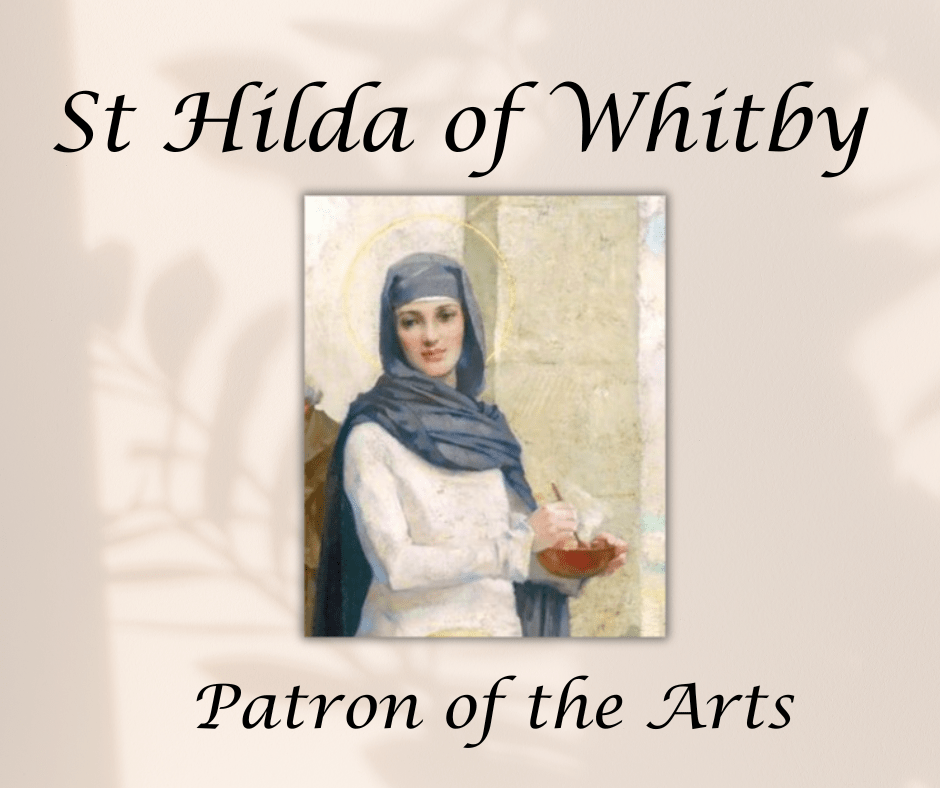
The Revd Hazel M Aucken writes, “I’ve been following Sue’s blogs of early Christian female pioneers with interest, not least because I trained for ordination at St Hild’s College, based in Sheffield, Mirfield, York and online. It’s an amazing seat of inspirational learning, founded as recently as 2017, with a name `chosen to capture our rootedness in the Yorkshire region, a depth of engagement with historic tradition, and a missionary spirit for our times.´ Hild of Whitby was clearly an amazing lady and an inspiration for us all.”
Taking Hazel’s thoughts as inspiration, I would like to write about the 7th Century St. Hilda, or Hild, Abbess of Whitby (614 – 684). Overlooking the town of Whitby on the north-east coast of England, the Abbey stands high on an outcrop of land, overlooking the sea, and claims attention above the noise of those who visit the town for its connection with Bram Stoker’s Dracula. The ruined abbey, standing sentinel, post-dates its famous Abbess, Hilda, by about 400 years. Yet it is still possible to catch a glimpse of St. Hilda there.
Hilda spent half her long life as a princess and half as a nun and abbess. Most of what we know about her comes from Bede’s Ecclesiastical History, written in the 8th century. She was one of the first in Northern England to convert to Christianity and, at the age of thirteen, was baptised in a timber church close to today’s York Minster. She spent the first half of her life as an Anglo-Saxon princess at court.
At 33, she left the court and went to Aiden of Lindisfarne to train as a nun in a small monastery on the banks of the River Wear. Brought up firmly in the Celtic tradition, Aidan made her Abbess at Hartlepool before King Oswy gave her land at Whitby to establish a double monastery, that is, one for both men and women who worshipped and worked together.
The Synod of Whitby
Having been brought up at court, Hilda was well-versed in politics, and the monastery was well-connected with the rulers of the Anglo-Saxon kingdoms, where she often served as a royal adviser. The monastery and Hilda would go on to play a part in one of the pivotal events in the church in England. By the year 664, tensions between Christians of the Celtic and Roman traditions had come to a head, and King Oswy held a synod at Whitby.
Hilda was seen as a bridge between the two traditions, as she was brought up in the Roman tradition and trained under Aidan in the Celtic tradition. She would have played a role as a “peace weaver” (1), keeping tensions between the two parties at bay. It was here that the Roman regulations were imposed, and some Celtic monks moved away to Ireland.
Patron and mentor of the arts
Hilda is remembered as a patron of the arts, and a story I recall from junior school is about a monk named Caedmon. As someone who simply tended to the animals, Caedmon considered himself not musical, and when the monastery gathered to sing and play music in the hall, he would leave, thinking he had nothing to offer. But one evening while he slept, “a man” visited him and told him to sing about “the beginning of created things.” Hilda found out and encouraged him to become a monk, and he went on to compose his poem, which is recorded by Bede as the oldest Old English poem to survive in manuscript form.
One feature of the British landscape are the free-standing stone crosses, which stand in marketplaces, particularly in the north of England. At first, these were small, but after the Synod, they became taller and more elaborately carved. Rather than being made of wood, which rots, these stone crosses were permanent fixtures in the landscape, and many survive to this day. These seem to have originated in and around Whitby.
As a mentor, Hilda encouraged many important men and women who passed through the monastery, including five future bishops. It may be surprising to hear about an early medieval woman with such power and influence in the state and church, but she stood at a transitional moment in history.
“The role of women would change as the church increasingly controlled, monitored and suppressed their influence, but Hilda represents a high point for early medieval Christian women. She is not alone, either.” (2)
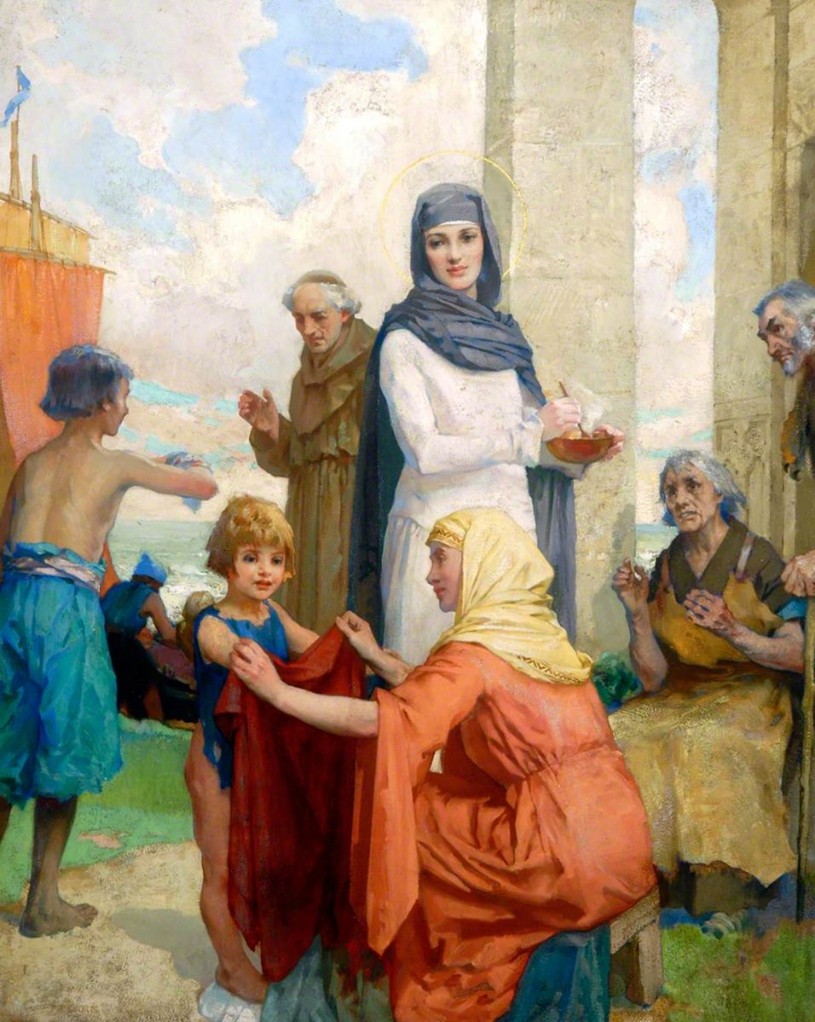
St Hilda at Hartlepool by James Clark 1925
Hild of Whitby was clearly an amazing lady and an inspiration for us all.
The Revd Hazel M Aucken
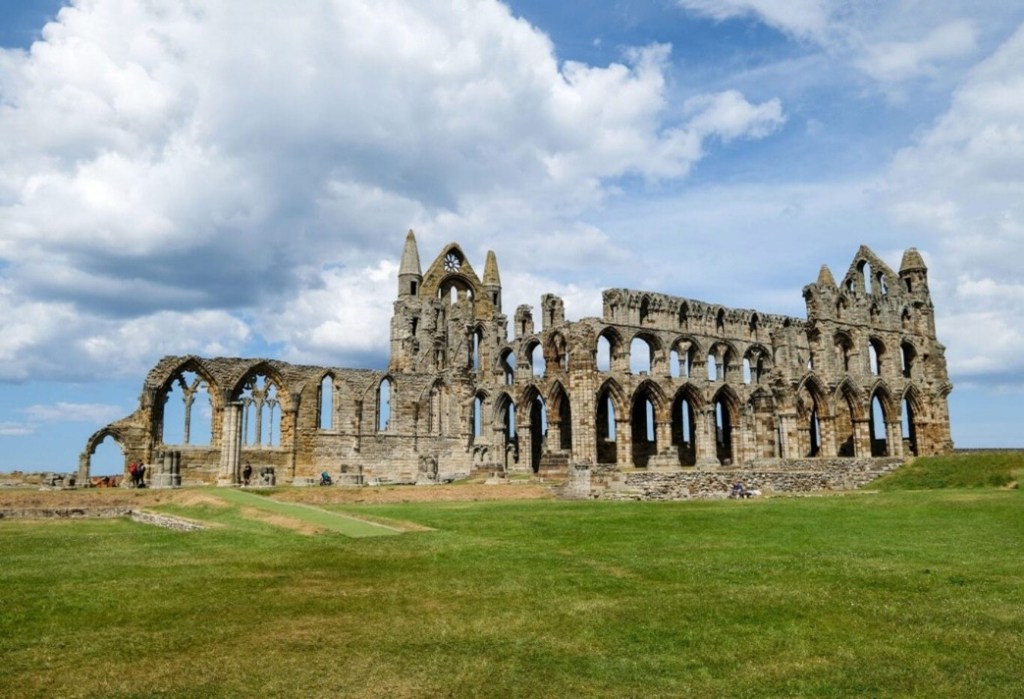
Whitby Abbey. Shared under the Creative Commons Attribution-Share Alike 2.0 Generic license. Attribution: Jeff Buck
Hilda played a role as a “peace weaver”
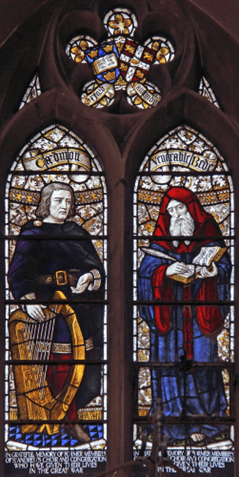
Caedmon and Bede depicted in stained glass. Shared under the Creative Commons Attribution-Share Alike 2.0 Generic license. Attribution: St Andrew, Bethune Road – Stained glass window by John Salmon
“Now we must honour the guardian of heaven. The might of the architect, and his purposes
The work of the father of glory as he. The eternal Lord, established the beginning of wonders.”
Caedmon
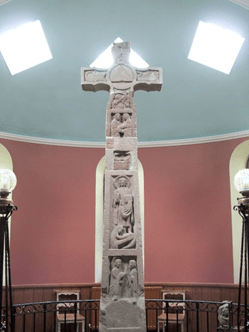
Ruthwell stone cross
“As your servant, Hilda shone like a jewel in the church, may we now delight to claim her gifts of judgement and inspiration reflected in the women and men of this age.”
Ray Simpson

Susan Sutherland is the author of the Leaving Bethany Trilogy. To buy Leaving Bethany, Return to Caesarea and Advance from Antioch please go to the buy page.
If you like Susan’s blogs sign up for the mailing list and receive a free copy of The Aemilia Metella Interviews.
(1) Ramirez J, (2015) The Private Lives of the Saints, Power, Passion and Politics in Anglo-Saxon England, Penguin, p 263
(2) Ramirez J, (2015) p269
(3) Simpson R, (1997) Celtic Worship Through the Year, Hodder and Stoughton, p230
 Leaving Bethany
Hi Sue, Have you read the Abbess of Whitby by Jill Dalladay? https://suestrifles.wordpress.com/2016/03/26/what-i-read-in-march-2016/
LikeLike
Hi Sue, I am not familiar with that book, but as a lover of historical fiction, I’ve just checked it out and it sounds interesting.
LikeLiked by 1 person