Our names are very important to us, and having had the privilege of naming two new humans, it can also be quite daunting to wonder whether the name we give them as babies will suit them as adults. My granddaughter was born a few months ago, and I discovered her name while in the queue at a well-known coffee shop on my way to see her for the first time. The whole place knew her name when I shouted it out. Even after such a short time, she is growing into her wonderful Biblical name, which suits her perfectly. The UN Convention on the Rights of the Child states that all children should have a registered name that does not degrade their dignity.
On a lighter note, as a fiction writer, I love naming my characters in ways that reflect their personalities and what they will do in the story. Even naming pets can be problematic. A young son of a friend once announced that, after thinking for a long time, he had decided on a good name for his guinea pig – Dave!
The Bible contains many stories about women and men, though we don’t always know their names. In Jesus’s time, the culture considered women as part of the honour-shame culture, and women were often referred to in relation to a man, father, husband, or brother. Remarkably, not only are so many women mentioned in the Bible, but we also know many of their names. (1)
Sometimes, we might get the impression that they were not important enough to be named. However, Jesus’s dealings with women were not dictated by his culture. The Gospels recount numerous instances where Jesus encountered and engaged with women, including those society would have typically ostracised. You can read more about Jesus’s engagement with women in one of my previous blogs.
It is the story of some of these unnamed women that I want to highlight in my new series of three blog posts. This first one will tell us about two of them.
The Widow of Nain
Luke is the only Gospel that records the raising of the widow of Nain’s dead son back to life. (Luke 7:11-17). We know very little about her, except that she was a widow who had lost her only son the day before Jesus arrived at her village with a large crowd following him. In a patriarchal society, a woman usually passed from father to husband to son as a guardian. Now this poor woman has no one to protect her and has suddenly become very vulnerable.
We are told that Jesus saw the widow as her son’s funeral procession passed by him. She was a poor woman in a poor village, and perhaps not many of those who had accompanied Jesus saw her. But he did. He noticed the woman no one else saw and felt deep compassion for her difficult situation. Here, in this little village, he does the unthinkable. He touches a corpse and breaks the rules on holiness. We are not told her reaction to being given her only son back from the dead, or how her friends and neighbours react to the news. Or the reaction of the crowd to Jesus touching a corpse.
My fictitious Roman journalist, Aemilia Metella, interviewed the widow, and you can read her story here. Aemilia Metella Interviews the Widow of Nain
A daughter of Abraham, the woman bent double for 18 years
This story appears in Luke 13:10-17 and is another story of a nameless woman found only in Luke. He tells us that Jesus saw a woman in the synagogue who had been bent double for 18 years. Just try bending over and see the difficulty you will have walking around and speaking to people. It must have been socially isolating, as well as physically painful for her. Like the widow of Nain, she did not ask for healing, and it was Jesus who saw her need. He must have bent down to speak to her, as she could not look up at him.
Jesus touches her, and she is instantly healed and stands up. This is more than just physical healing; it is social and emotional as well. She can now stand upright and look people in the eye for the first time in 18 years. Her reaction is to start praising God for her healing.
It is at this point that trouble arises, as her healing occurred on the sabbath, and the synagogue authorities were outraged. Jesus has, yet again, seemingly broken the rules, and they tell him so. They argue that there are six days in a week to work, and she should come back for healing another day. (2)
Jesus responds that if it is permissible to untie your donkey to take it to water on the sabbath, then it is right that she is freed from her bondage on the sabbath. He is not willing to let her suffer for another day, and she is restored to wholeness.
We are not told her name, but Jesus called her a daughter of Abraham. Ben Witherington notes that this term is rare and is usually applied to Israel as a whole, not to an individual. “By using the title, Jesus implies that she is as worthy of his concern and healing as any Jewish man and has as full a claim to her religious heritage as anyone else.” (3)
These two women have something in common: they did not approach Jesus either for healing for themselves or for their son to be restored to them, but it was Jesus who saw them. History does not tell us their names, but he knew them.
Next month’s blog will look at some more unnamed women we find in the gospels.

Photo by CHUTTERSNAP on Unsplash
The UN Convention on the Rights of the Child states that all children should have a registered name that does not degrade their dignity.
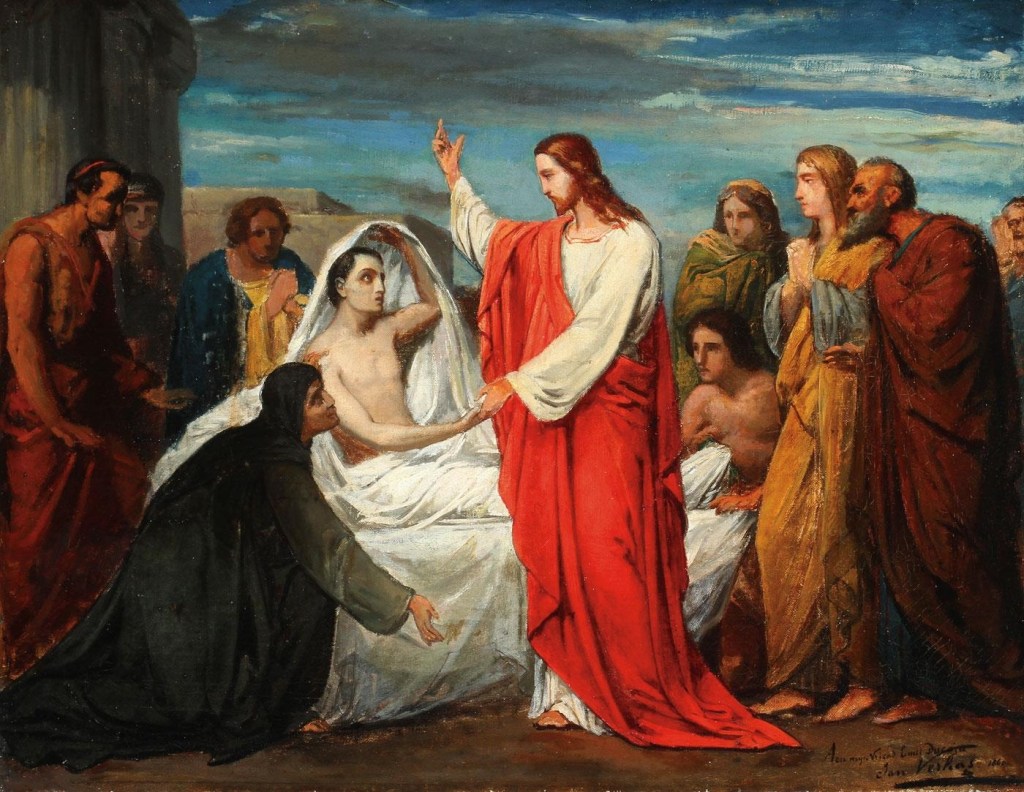
Jan Verhas Raising the Son of the Widow of Nain 1860
“When the Lord saw the grieving mother, his heart broke for her. With great tenderness, he said to her, `Please don’t cry.´” Jesus Luke 7:13, TPT
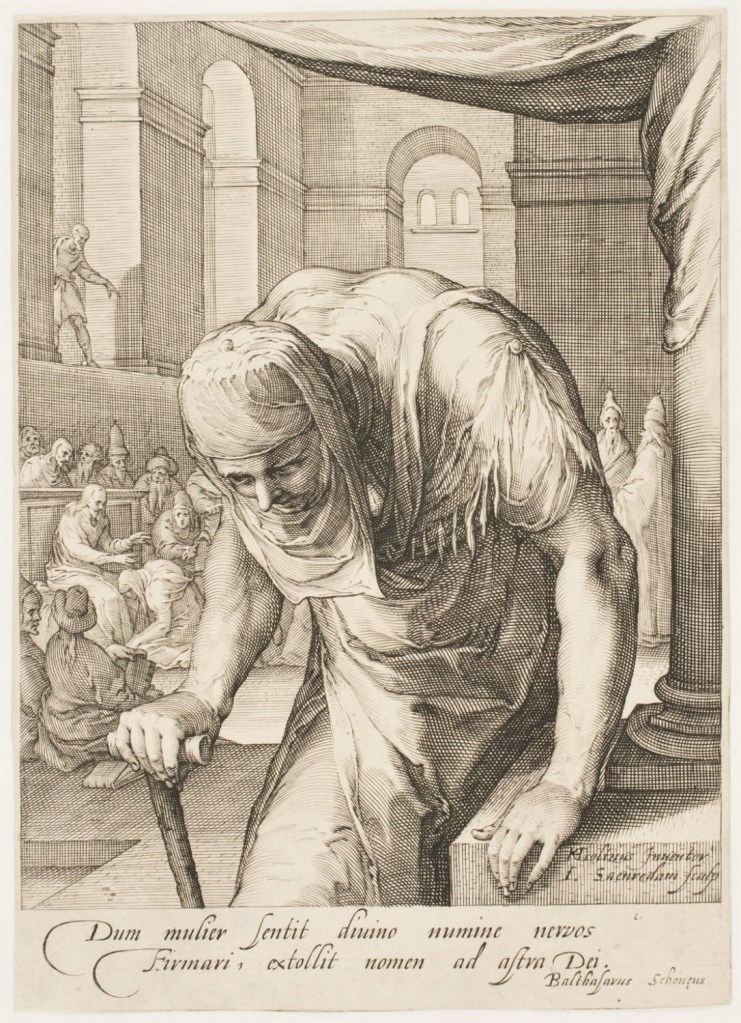
Jan Pieterszoon Saenredam A Crippled Old Woman Healed by Christ 1594
“When Jesus saw her condition, he called her to him and gently laid his hands on her. Then he said, `Dear woman, you are free. I release you forever from this crippling spirit.´“ Jesus Luke 13:12 TPT
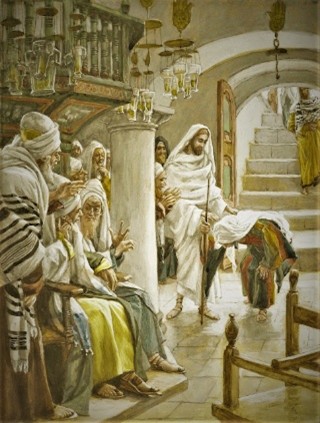
James Tissot, Jesus Healing the Woman 1886 -1894
“By using the title, Jesus implies that she is as worthy of his concern and healing as any Jewish man and has as full a claim to her religious heritage as anyone else.” Ben Witherington

Susan Sutherland is the author of the Leaving Bethany Trilogy. To buy Leaving Bethany, Return to Caesarea and Advance from Antioch please go to the buy page.
If you like Susan’s blogs sign up for the mailing list and receive a free copy of The Aemilia Metella Interviews.
(1) Mowczko M, (2013) The Shame of the Unnamed Women of the Old Testament
(2) Bruce K and Shercliff L, (2024) SCM Press
(3) Ben Witherington III, Women and the Genesis of Christianity, edited by Ann Witherington (Cambridge: Cambridge University Press, 1990), 78–80. Quoted in https://margmowczko.com/jesus-and-infirmed-bent-over-woman-luke-13/
 Leaving Bethany