Philip’s Four Prophesying Daughters
You often see personalised gifts on the shelves of garden centres and gift shops, and I can never resist looking for my family members’ names. Recently, I bought a photo frame that explained the meaning of my new granddaughter’s name. The name Susan comes from the Hebrew name Shoshannah and means “lily” or “lotus flower,” symbolising beauty, purity, and grace. Whether those qualities describe me accurately is something I’ll leave to those who know me to decide.
This is the third part of the series on unnamed women in the New Testament. So far, we have looked at women in the gospels, the widow of Nain and the woman bent double in part 1 and the poor woman who gave away her last coins and the Samaritan woman in part 2. Now we are going to look at four unnamed sisters we find in the book of Acts. The Acts of the Apostles is the book in the Bible found after the Gospels, and it tells the history of the church from its first faltering steps.
We find them in Acts chapter 21 and verses 8-9. They are the four unmarried, some versions call them virgin daughters of Philip the evangelist. Some versions say that they prophesied, or that they were prophetesses. Perhaps when Luke wrote his account of the early church, they were so well known that he did not need to mention any other details about them.
They lived in Caesarea with their father Philip, and the records remain silent regarding their mother or any other siblings. Luke says that he, Paul, and their team stayed with them in Caesarea on the way to Jerusalem. Later, Paul spent two years in detention in Caesarea, and they likely met up again. According to Eusebius, a fourth-century church historian and bishop, in later years, they were renowned as authorities on both the people and events of the earliest days of Christianity, and people travelled great distances to meet them. (1)
Hermoine and Eutychis (or Eukhidia or Eutcychia) are two of their names preserved in the Greek Menaon’s list of saints and martyrs. (2) Tradition also names the other two as Irais and Chariline. (3)
The Bible describes their father, Philip, as an evangelist. He was chosen as one of the seven deacons in Acts 6, where those appointed were required to be full of the Spirit and wisdom. Acts 8 records his later ministry and experiences. Philip would undoubtedly have had a great influence on his daughters, who later became well known in the early church.
The Life of Saint Hermione
Of all the sisters, only Hermione has her own hagiography, which is the story of the life of a saint. While living in Caesarea with her family, she studied medicine until they had to leave because of anti-Christian forces and settled with the family in Hieropolis, in modern-day Turkey, where there were healing mineral springs. She eventually made her home in Ephesus, where she founded a medical clinic and offered her services for free. Her sister, Eutychis, joined her for a while.
Hermoine expanded her clinic by adding rooms for ill homeless people and travellers. She cared for both the physical and spiritual needs of those in her charge, and her hagiography notes that the Holy Spirit filled her with grace and gave her the gift of prophecy.
Despite her old age, she was arrested and tortured, but she would not renounce her faith. There is some discrepancy as to her death; some say that a frustrated Roman official had her beheaded, and others that she miraculously escaped and lived the rest of her life in peace in Ephesus, where she is buried. (4) (5)
Their Prophetic Ministry
Eusebius equates the sisters with another prophet called Quadratus, and said all four had a prophetic gift, implying that they took over the Apostles’ ministry. (6) He includes them in a list of prophets, which includes Agabus, Judas, and Silas from Acts, showing there was no difference between the ministry of male and female prophets.
“Eusebius regards Philip’s daughters and their ministry as the benchmark for prophetic ministry in the early church.” (7)
The book of Acts starts with Pentecost in chapter 2, where the Holy Spirit fell on the small group of believers and changed everything. Afterwards, in his speech, the apostle Peter quotes the prophet Joel that God would pour out his Spirit on their sons and daughters.
Prophets had a special role in the early church, and Paul says in 1 Corinthians 14:1 that we are to eagerly desire the gifts of the Spirit, especially prophecy. “But the one who prophesies speaks to people for their strengthening, encouraging and comfort… the one who prophesies edifies the church.” (1 Corinthians 14:3-4 NIVUK)
Paul lists the gifts of the Spirit in three places in his letters: Romans 12:6-8, I Corinthians 12:28, and Ephesians 4:11. Each time, prophecy appears before teaching. The gift of prophecy is not less important or official than teaching, and if it is a gift open to women, then so are the rest of the gifts.
Conclusion
The early church remembered the names of the four prophesying sisters after their brief, one-verse mention in the Bible, and they respected and recognised their gifting alongside their male contemporaries. It is a shame that their names have become lost in the subsequent centuries.
Throughout this brief series of three posts, I have highlighted just a few of the unnamed women in the New Testament. It makes me wonder how many women today go unnoticed in their ministry, perhaps because their work is not considered as significant as some of the more visible roles within the church. Let us recognise these women, tell their stories, and express our appreciation for the vital contribution they make.
Cover of Return to Caesarea, Susan Sutherland
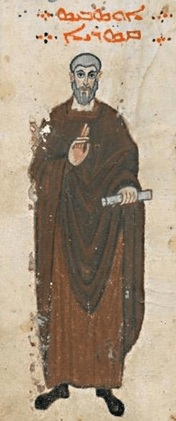
6th century Syriac portrait of St. Eusebius of Caesarea from the Rabbula Gospels
They were renowned as authorities on both the people and events of the earliest days of Christianity, and people travelled great distances to meet them.
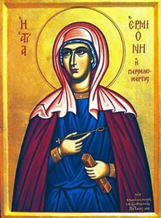
St. Hermoine
Despite her old age, she was arrested and tortured, but she would not renounce her faith.
“Eusebius regards Philip’s daughters and their ministry as the benchmark for prophetic ministry in the early church.” Marg Mowczko

Susan Sutherland is the author of the Leaving Bethany Trilogy. To buy Leaving Bethany, Return to Caesarea and Advance from Antioch please go to the buy page.
If you like Susan’s blogs sign up for the mailing list and receive a free copy of The Aemilia Metella Interviews.
(1) The New Bible Commentary Revised, (1970) Inter-Varsity Press, page 1001
(2) Marg Mowczko, Philip and his Daughters in the New Testament https://margmowczko.com/philips-prophesying-daughters/
(3) Marg Mowczko
(4) Mark Carson-Ghost Philip’s Daughters, “Great lights” of the Early Church-https://www.markcarlson-ghost.com/index.php/2016/09/17/philips-daughters-prophets-names/
(5) St. Ermione (Hermione) the daughter of St. Philip the Deacon https://full-of-grace-and-truth.blogspot.com/2009/09/st-ermione-hermione-daughter-of-st.html
(6) Marg Mowczko
(7) Marg Mowczko


Amen. Let us honour every person’s contribution to the body of Christ. I love these studies you do!
LikeLike