
My last post, Hidden Voices, set off a brand-new series on the hidden women in church history in their own words. This introduction showed that women have always been thinkers, writers, theologians, and teachers throughout history, but many of their stories have been forgotten, or worse, deliberately suppressed. In this series, I want to bring even a few of these hidden women into the light and let their words speak for themselves.
This post shines a spotlight on two young women, one of whom wrote a prison diary before their execution. They were Vibia Perpetua, a well-born mother of a young son, and Felicitas, a pregnant enslaved woman. I first wrote about these two remarkable women in June 2024, in a series called Celebrating Women Pioneers of the Early Church. I now want to share more of Perpetua’s writing with you.
The Passion of Perpetua and Felicitas is an account of their trial, imprisonment, and final martyrdom. More than a third of the account is Perpetua’s first-person writing, and we hear her voice from prison. Although the Passion’s authorship was once disputed, scholars now agree that Perpetua wrote her prison diary. (1) This is the first written autobiography by a woman, and one of the first by either a man or woman. The account of their deaths was added later.
You can read The Martyrdom of Saints Perpetua and Felicitas for yourself and read more of her experiences and visions whilst in prison.
Both women were married; Perpetua had a young son whom she was still breastfeeding, and Felicitas was pregnant when they were arrested. Perpetua describes how her father tried many times to get her to recant her Christianity and worship the emperor, to save her life, but she refused.
While we were still under arrest (she said) my father out of love for me was trying to persuade me and shake my resolution. ‘Father,’ said I, ‘do you see this vase here, for example, or water pot or whatever?’
‘Yes, I do’, said he.
And I told him: ‘Could it be called by any other name than what it is?’ And he said: ‘No.’ ‘Well, so too I cannot be called anything other than what I am, a Christian.’
At this my father was so angered by the word ‘Christian’ that he moved towards me as though he would pluck my eyes out. But he left it at that and departed, vanquished along with his diabolical arguments.
Perpetua recounts her visions whilst in prison and how she encouraged the small group as the day drew near.
I saw a ladder of tremendous height made of bronze, reaching all the way to the heavens, but it was so narrow that only one person could climb up at a time. To the sides of the ladder were attached all sorts of metal weapons: there were swords, spears, hooks, daggers, and spikes; so that if anyone tried to climb up carelessly or without paying attention, he would be mangled and his flesh would adhere to the weapons.
At the foot of the ladder lay a dragon of enormous size, and it would attack those who tried to climb up and try to terrify them from doing so. And Saturus was the first to go up, he who was later to give himself up of his own accord. He had been the builder of our strength, although he was not present when we were arrested. And he arrived at the top of the staircase and he looked back and said to me: ‘Perpetua, I am waiting for you. But take care; do not let the dragon bite you.’
‘He will not harm me,’ I said, ‘in the name of Christ Jesus.’
Slowly, as though he were afraid of me, the dragon stuck his head out from underneath the ladder. Then, using it as my first step, I trod on his head and went up.
Then I saw an immense garden, and in it a gray-haired man sat in shepherd’s garb; tall he was, and milking sheep. And standing around him were many thousands of people clad in white garments. He raised his head, looked at me, and said: ‘I am glad you have come, my child.’ He called me over to him and gave me, as it were, a mouthful of the milk he was drawing; and I took it into my cupped hands and consumed it. And all those who stood around said: ‘Amen!’ At the sound of this word I came to, with the taste of something sweet still in my mouth. I at once told this to my brother, and we realized that we would have to suffer, and that from now on we would no longer have any hope in this life.
Even though they knew execution awaited them, this vision must have strengthened their conviction that their impending death signified ultimate triumph, not an ending. They prayed Felicitas would give birth before their execution date so that she could be martyred alongside them, rather than on her own later. It was the 7th of March 203, after she had given birth, that along with a group of men and women they were led into the amphitheatre in Carthage.
A heifer first gored the two women until the crowd shouted that it was enough. In a show of solidarity, the two women clung to each other for comfort. Gladiators were sent to kill them, and the narrator tells us at the end of the Passion, that a young gladiator was sent to despatch Perpetua. She took his trembling hand and guided his sword to her throat.
Like other early prison writings, such as Ignatius of Antioch (c. 67AD) and even the letters of the Apostle Paul written from prison, Perpetua’s accounts offer powerful reflections on their impending martyrdom and vivid visions and imagery. That her account was added to and distributed shows how important it was for the early believers. It must have been very encouraging at a time of persecution.
For modern readers, it opens a window on how early Christians engaged with the vision literature of the Bible, as well as a commentary on their struggles in living out their faith and eventual martyrdom for many. It is a story of two faithful women, written from their perspective, as a mother and a pregnant woman, concerned for their children. We may not face physical martyrdom, but there is much to inspire and learn from how Perpetua faced her death.
Next time I will examine how two women writers of the fourth and fifth centuries, Faltonia Betitia Proba and Aelia Eudocia Augusta, used the literary forms of their day to write about scripture.
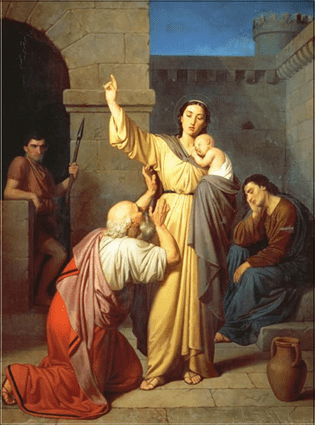
Saint Perpetua Comforting her Father, Antonio Ridolfi, 1857
She replied, “I cannot be called anything other than what I am, a Christian.”
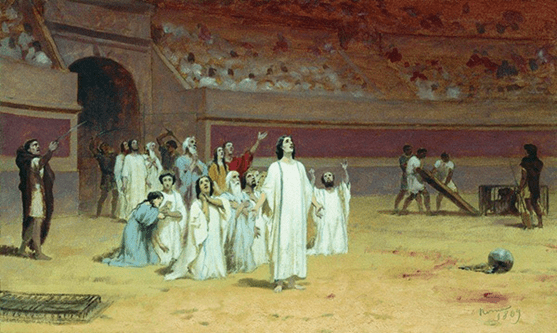
Before entering the Arena, Fyodor Bronnikov, 1873
“Slowly, as though he were afraid of me, the dragon stuck his head out from underneath the ladder. Then, using it as my first step, I trod on his head and went up.”
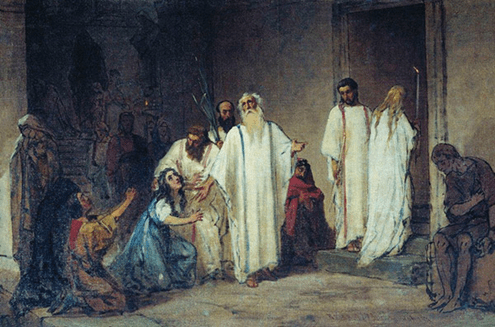
Entering the Arena, Fyodor Bronnikov, 1869
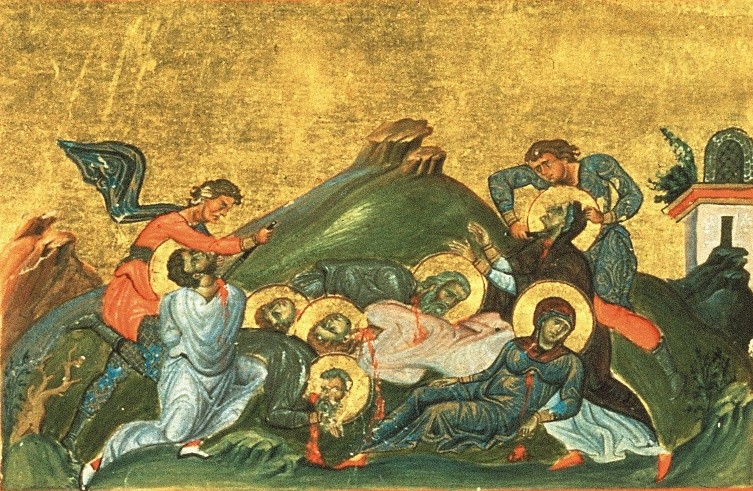
The martyrdom of Perpetua, Felicitas, Revocatus, Saturninus and Saturus from the Menologion of Basil II (c. AD 1000)
“Stand fast in the faith, and love one another, all of you, and be not offended at my sufferings.”

Susan Sutherland is the author of the Leaving Bethany Trilogy. To buy Leaving Bethany, Return to Caesarea and Advance from Antioch please go to the buy page.
If you like Susan’s blogs sign up for the mailing list and receive a free copy of The Aemilia Metella Interviews.
(1) Schroder, J.A and Taylor, M.A. (2022) Voices Long Silenced, Women Biblical Interpreters Through the Centuries, Westminster John Knox Press, page 13
https://www.ssfp.org/pdf/The_Martyrdom_of_Saints_Perpetua_and_Felicitas.pdf


One thought on “Hidden Voices Perpetua and Felicitas”