Welcome to the third in my series of Hidden Voices: The Hidden Women in Church History in their own Words. Last month we read the prison diary of Vibia Perpetua, the third-century martyr and the first woman to write an autobiography.
This post will share the writings of two women from the fourth and fifth centuries who explored the Bible and biblical themes. As a writer, I am fascinated to know that women were writing their thoughts, hopes, and ideas way back in antiquity. Women writers are not a new thing, and writers today follow in their footsteps.
Cento
A cento, literally meaning a patchwork quilt, was a poetic form popular in late antiquity. Writers created a new poem by selecting and stitching together lines from well-known classical works, such as those of Homer or Virgil. Readers would recognise the original verses and appreciate the skill involved in giving familiar words a new meaning within a different story.
Faltonia Betitia Proba and Aelia Eudocia drew on their education in classical Greek literature to adapt the cento form to express their Christian faith. By reshaping familiar classical poetry, they created works that connected the world their readers knew with the Christian story they wanted to tell.
For centuries, their work was criticised, including by Jerome, who questioned their use of pagan classical texts. Later scholars criticised them for taking apart the carefully constructed poetry of Virgil and Homer and rearranging it into what they considered inferior works.
Such criticism, however, misunderstands the purpose of the cento. Its creativity lay precisely in taking familiar words and transforming them into something new. Modern scholars have increasingly recognised the ingenuity, literary skill and creativity of both women. Their work is now valued as an important part of the transformation and Christianisation of classical literary traditions. (1)
Faltonia Betitia Proba (ca.320–ca.370)
Proba came from a wealthy Roman family and embraced Christianity later in life. Her husband and sons eventually joined her in her faith. She would become recognised as one of the most prolific female poets of ancient times.
She was the author of Cento Vergilianus and referred to herself as “Proba Vates” meaning prophet or bard. This work retells Genesis chapters 1-4 and the Gospel of Matthew. The stories of Jesus’s birth focus on Mary as the central character, and she describes Jesus’s ministry, passion and ascension.
Of the creation, she writes:
“Then God, all powerful, to whom belongs Supreme dominion of the universe, Moved murky air apart, dispelled the shades, Gave half the world to light and half to gloom. All constellations wheeling in the silent sky He marked, surveying here and there with watchful eyes.” Proba Cento lines 64-68 (2)
She describes how Eve is plucked from the rib of Adam, and they join hands in marriage, like the Roman tradition, and embrace. Then the serpent approached Eve.
“Tell me,” it said, “O maid – my home is in the dim-lit woods; on slopes of river banks I dwell, and meadows freshened by streams – What cowardice has come upon your daring? Strewn everywhere lie fruits, each beneath its tree.” Probo Cento, lines 183-86 (3)
Proba follows tradition in assigning Eve the blame for the fall and Adam’s sin.
“She rose to greater madness; wife, alas, she thrust in wretched Adam’s way the fruit from the forbidden tree, and moved his mind with unexpected charm.” Proba, Cento, lines 203-5 (4)
The Cento Probae was first published in 1472 and enjoyed popularity in the Middle Ages. It is quite possible that Proba was the first woman author to have her work made available in print.
Proba was criticised by her contemporary Jerome because of her use of the pagan poets. He wrote about a “chatty old woman”, which is almost certainly referring to Proba and mocked her for using a line of Virgil to describe the crucifixion.
Empress Aelia Eudocia Augusta (ca. 400-460)
Eudocia’s father was Leontius, a Greek philosopher, who taught his daughter alongside his sons. She was well-versed in the Greek classics, which she would have memorised. After her father’s death, she moved to Constantinople and married the Emperor Theodosius. Eudocia was then baptised as a Christian and received the name Augusta.
She went on a pilgrimage to Jerusalem and permanently moved there in 443. While there, she worked on both philanthropic and literary work, including a paraphrase of the first eight books of the Old Testament and Daniel and Zechariah. Unfortunately, these are now lost.
Her principal work is the Homerocentones, Homeric Verses on the Life of Christ. (Homeric Centos) comprising 2,400 lines. She writes that she expanded the writing of a fourth-century bishop called Patricius, about whom little is known. She corrected his work and added three-quarters of the poem’s lines. It tells the story of creation, the life of Christ, and Biblical narratives, constructed entirely from the verses of Homer’s Iliad and Odyssey, blended with Christian narrative. It established her as an authoritative voice in Christian literature and demonstrated her mastery and ability to weave a coherent Christian narrative out of the inherited pagan verse.
Following the church tradition of the time, she imagines Mary spinning wool when the angel appeared.
“He entered an elaborate room–there was the girl, Sitting on a couch, a footstool supporting her feet as she spun yarn into a thread, a wonder to see.” Homerocentones lines 209-11 (5)
“Through Your cross, You made amends for his punishment, And, in the name of Christ, You cleansed all his sufferings (sins) For this reason, the inexhaustible earth shines forth.” Eudocia’s Martyrdom of Cyprian Book 1: The Conversion line 75 (6)
If you would like to read more about her, download Brian P. Sowers’ book, In Her Own Words: The Life and Poetry of Aelia Eudocia
As both a writer and someone who has made patchwork quilts, I appreciate the skill and creativity with which these two women used the art of the cento to create new expressions of their Christian faith. Like Proba and Aelia Eudocia, I use an art form suited to the audience of my own time, the contemporary novel and the genre of Biblical fiction.
In Leaving Bethany, I retell the story of Martha of Bethany, imagining her journey of faith after meeting Jesus and witnessing his death and resurrection for a new generation of readers.
It is encouraging to recognise that I belong to a long tradition of women writers who have used the art forms available to them to tell stories of faith and ensure their voices are heard.
Next time we will listen to the hidden voice of Egeria, a fourth century travel writer.
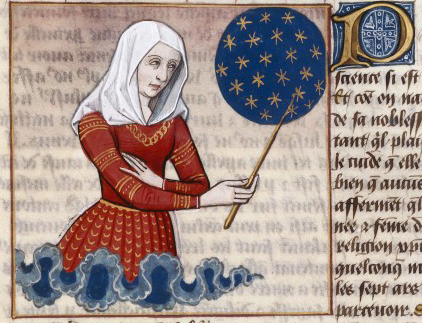
Faltonia Proba teaching the history of the world since the Creation through her Cento Vergilianus de laudibus Christi. Miniature from a 15th-century manuscript of the De mulieribus claris by Giovanni Boccaccio
“All constellations wheeling in the silent sky, He marked, surveying here and there with watchful eyes.”
Faltonia Betitia Proba
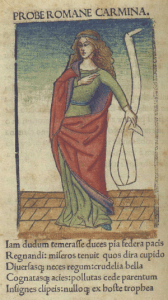
The first five lines of Cento Probae with a depiction of the author, Faltonia Betitia Proba, holding a scroll. From standrewsclassics.wordpress.com/2016/03/09/faltonia-betitia-
“Through Your cross, You made amends for his punishment, And, in the name of Christ, You cleansed all his sufferings (sins) For this reason, the inexhaustible earth shines forth.”
Aelia Eudocia Augusta
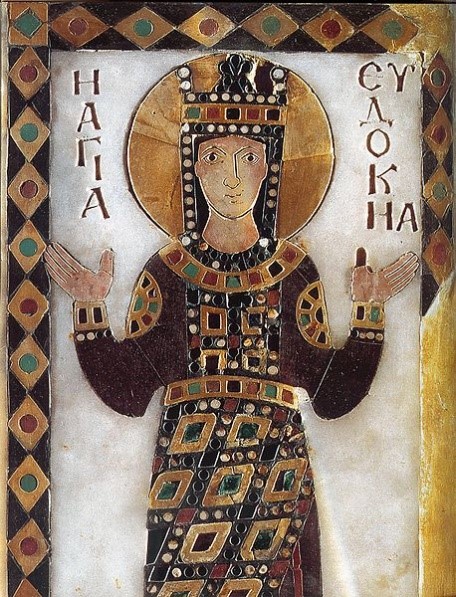
unbekannt, Pitichinaccio, Public domain, via Wikimedia Commons

Susan Sutherland is the author of the Leaving Bethany Trilogy. To buy Leaving Bethany, Return to Caesarea and Advance from Antioch please go to the buy page.
If you like Susan’s blogs sign up for the mailing list and receive a free copy of The Aemilia Metella Interviews.
(1) Schroder J and Taylor MA (2022), Voices Long Silenced, Women Biblical Interpreters Through the Centuries. Westminster John Knox Press
(2) Schroder J and Taylor MA (2022)
(3) Schroder J and Taylor MA (2022)
(4) Schroder J and Taylor MA (2022)
(5) Schroder J and Taylor MA (2022)
(6) Brian P. Sowers (2020), In Her Own Words: The Life and Poetry of Aelia Eudocia https://chs.harvard.edu/read/sowers-brian-p-in-her-own-words-the-life-and-poetry-of-aelia-eudocia/


Absolutely fascinating, and incredibly clever on their part to tell one story using someone else’s different story words!
LikeLike
How wonderful! I had never heard of this literary form of cento. I want to read more now. Thank you Sue. x
LikeLike