Fourth Century Travel Writer
Only four major works by women interpreters of scripture have survived from late antiquity. Three of whom we have already met in my two previous blogs: the prison diary of Perpetua, and the centos of Faltonia Betitia Proba and Empress Eudocia. Now, in this series of hidden women in church history, we turn to the fourth of these major works and to Egeria and the diary of her travels through the Holy Land. (1)
In this world of travel influencers taking selfies in spectacular scenery, we could be forgiven for thinking that this was a modern phenomenon, but travel writing has a long tradition. Egeria may not have been the first, with Herodotus doing so six centuries earlier, but she was probably the first woman to write of her travels, sometime between 381 and 384. (2)
“We reached the mountain late on the Sabbath, and arriving at a certain monastery, the monks who dwelt there received us very kindly, showing us every kindness; there is also a church and a priest there. We stayed there that night, and early on the Lord’s Day, together with the priest and the monks who dwelt there, we began the ascent of the mountains one by one. These mountains are ascended with infinite toil, for you cannot go up gently by a spiral track, as we say snail-shell wise, but you climb straight up the whole way, as if up a wall, and you must come straight down each mountain until you reach the very foot of the middle one, which is specially called Sinai. By this way, then, at the bidding of Christ our God, and helped by the prayers of the holy men who accompanied us, we arrived at the fourth hour, at the summit of Sinai, the holy mountain of God, where the law was given.” Egeria Diary 3.1 (3)
Her diary was discovered in 1884, and unfortunately it is not complete, with pages missing at the beginning and at the end, as well as a few in the middle. It only survives as a single manuscript produced in the 11th century at the monastery of Monte Cassino. This is now held at the municipal library in Arezzo, Italy. Her writings and diary were popular in the Middle Ages, and other works referred to her diary and writings.
Egeria, or Etheria, as she is sometimes referred to, was from northern Spain or perhaps Gaul, and her background is unknown. The diary is written in Old Latin and is addressed to the “ladies” or “the reverend sisters” back home. She may have belonged to a religious house, or was a widow, or a devout woman who had not taken vows. One thing we know is that she was a woman of status and wealthy enough to travel for three years with a small group of people and offer money to religious houses where they stayed.
Her writings are among the first Western reports of the Christian communities of the Holy Land, giving a description of the places, communities, and early Christian liturgy in Jerusalem.
Egeria wanted to see as many sites as in the Bible as possible, particularly in Genesis, Exodus and Deuteronomy. She visited places associated with Moses, Abraham and Sarah, as well as those where Jesus’ passion took place in Jerusalem.
At each site they stopped at, they would recite a prayer, read a passage of scripture applicable to the site and sing an appropriate psalm, and sometimes they would celebrate the Eucharist.
One day, she arrived at the cave on Horeb where Elijah had fled following his confrontation with King Ahab, in 1 Kings 19. Egeria writes,
“We offered the sacrifice (Eucharist) there, and recited a very fervent prayer, and the proper passage was read from the book of Kings. For this was always very much our custom, that whenever we should come to places that I had desired to visit, the proper passage from scripture would be read.” (4) Egeria Diary, 54
Her diary shows us Egeria’s love of learning and knowledge of scripture, as well as her devotion in visiting these places.
“Though I must always give thanks to God for all things, I shall not speak about the many favours which he deigned to confer upon me in spite of my own unworthiness and lack of merit, in allowing me to travel though all these places, which I do not deserve. Yet I cannot sufficiently thank all these holy (people) who so willingly consented to receive my humble person in their cells and above all to guide me through the places which I was forever seeking out, following Holy Scripture.” Egeria Diary 58 (5)
The value in her writings lies in her vivid first-hand accounts of the monastic and church buildings of the fourth century, alongside the development of early religious practices and liturgy associated with various pilgrimage sites. Her voice, devotion, and determination are heard in her writings.
Despite all the dangers of travel in the fourth century, particularly for a woman, Egeria must have been a courageous woman to undertake such a long pilgrimage. We can thank her for having the foresight and the education to write down her travels, and thank those who preserved them for posterity.
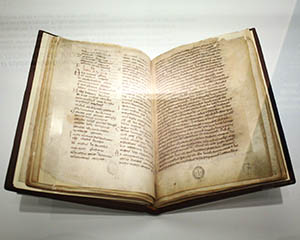
Codex Aretinus 405 contains the only surviving copy of Egeria’s Travels. Lameiro, CC BY-SA 4.0, via Wikimedia Commons
“By this way, then, at the bidding of Christ our God, and helped by the prayers of the holy men who accompanied us, we arrived at the fourth hour, at the summit of Sinai, the holy mountain of God, where the law was given.” Egeria Diary 3.1
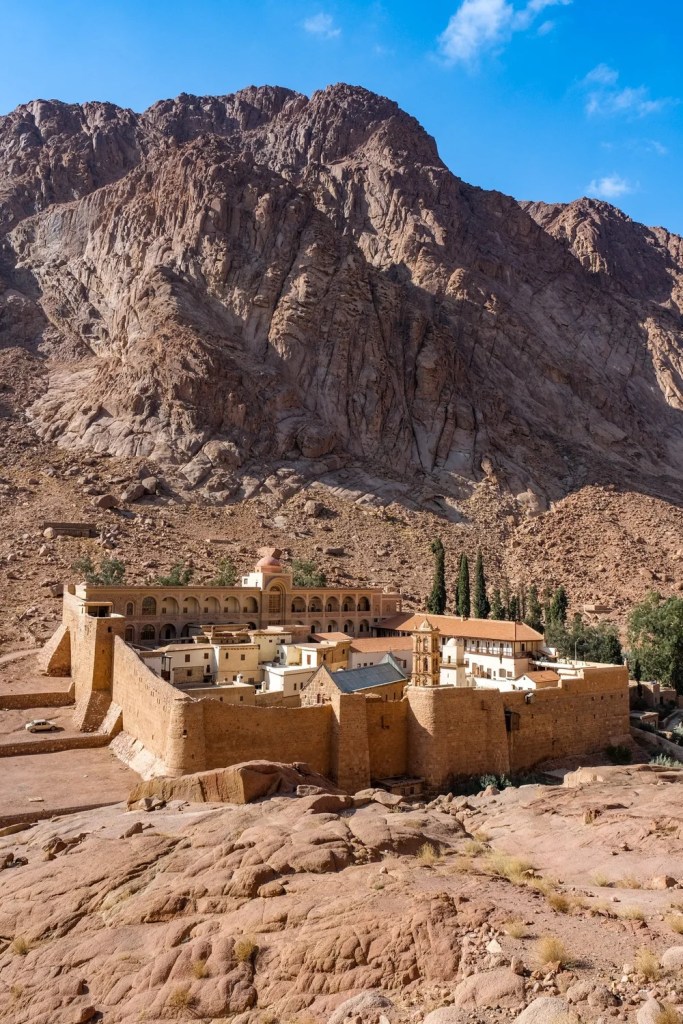
St Catherine’s Monastery, Sinai
“For this was always very much our custom, that whenever we should come to places that I had desired to visit, the proper passage from scripture would be read.” Egeria Diary, 54
“I shall not speak about the many favours which he deigned to confer upon me in spite of my own unworthiness and lack of merit, in allowing me to travel though all these places, which I do not deserve.” Egeria Diary 58

Susan Sutherland is the author of the Leaving Bethany Trilogy. To buy Leaving Bethany, Return to Caesarea and Advance from Antioch please go to the buy page.
If you like Susan’s blogs sign up for the mailing list and receive a free copy of The Aemilia Metella Interviews.
(1) Schroder J and Taylor MA (2022), Voices Long Silenced, Women Biblical Interpreters Through the Centuries. Westminster John Knox Press
(3) https://theambulist.co.uk/words-and-musings/heroines-seven-women/egeria
(4) Schroder J and Taylor MA (2022)
(5) Schroder J and Taylor MA (2022)


One thought on “Hidden Voices: Egeria”